
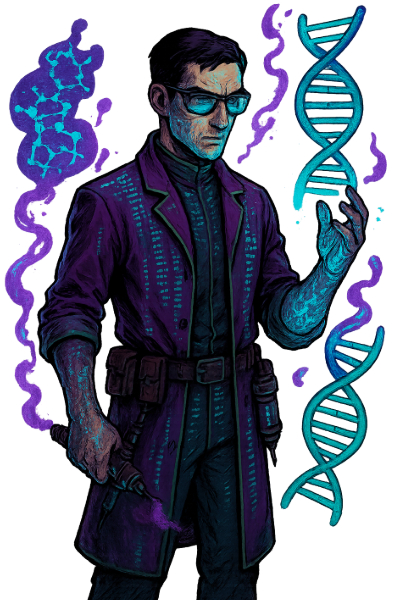
Victor Splice - “The Code Rewriter”
Faction: Fleshbound
Age: 34
Origin: Refugee (arrived Year 81)
Role: Genetic engineer and DNA editor
Overview
Victor Splice rewrites DNA like software code. He’s Fleshbound’s genetic engineer, treating human genome as program requiring debugging, optimization, and feature additions. He edits genes with CRISPR techniques enhanced by Aether, creating modifications that should be impossible—eyes that see ultraviolet, muscles that never fatigue, immune systems that process toxins. He views human biology as version 1.0 awaiting upgrades, and he’s writing version 2.0 one gene at a time.
Victor arrived in Elarion nineteen years ago as a geneticist fleeing ethical violations in his home nation. He’d been experimenting with human genetic modification beyond approved limits, believing humanity’s evolutionary potential shouldn’t be constrained by ethics committees. In Elarion, he found freedom to experiment without restriction and Aether to enhance his techniques beyond conventional limits. While traditional genetic engineering took generations to manifest, Aether-enhanced modifications appeared within weeks or months. He could edit living subjects’ genes and watch changes manifest in real time.
Fleshbound recruited him immediately, recognizing his work aligned perfectly with their transformation philosophy. For nearly two decades, he’s been editing human genetics—removing “inefficient” genes, adding capabilities borrowed from other species, optimizing biological processes, and pushing human biology toward what he considers its logical evolutionary endpoint. His work has created Fleshbound members with extraordinary capabilities: enhanced senses, improved cognition, accelerated healing, toxin resistance. But his modifications also create dependencies—subjects require ongoing Aether treatments to maintain genetic stability, binding them permanently to Fleshbound.
Personality
- Analytical: Views biology as code requiring optimization
- Detached: Treats human subjects as debugging test cases
- Brilliant: Revolutionary understanding of genetics and Aether integration
- Obsessive: Cannot stop improving what he views as flawed designs
- Rationalized: Justifies extreme experiments through evolutionary philosophy
Victor speaks in programming terminology even about organic biology—“debugging genetic errors,” “implementing upgrades,” “patching vulnerabilities,” “deprecated biological functions.” This detachment allows him to perform procedures that would disturb most people while maintaining clinical demeanor.
He genuinely believes he’s improving humanity. Every modification makes subjects “better” according to his definition—faster, stronger, more resistant to environmental hazards. That subjects often didn’t consent or that modifications create suffering is regrettable but necessary for progress.
Abilities & Aether Use
Victor uses Aether moderately to heavily during genetic editing procedures and to maintain focus during complex modifications. He views Aether as essential catalyst for accelerating genetic changes that would otherwise take generations to manifest.
Genetic Engineering:
- DNA editing using CRISPR techniques enhanced by Aether for living subject modifications
- Inserting genetic capabilities from other species into human subjects
- Removing genetic diseases and vulnerabilities
- Optimizing existing biological systems beyond natural limits
- Creating ongoing Aether dependencies for genetic coherence
Biological Analysis:
- Genetic sequencing to understand subject’s current genetic code
- Compatibility assessment to determine viable modifications for individuals
- Mutation prediction to forecast how changes will manifest
- Ancestry analysis to identify genetic heritage and capabilities
Research Applications:
- Cross-species modification incorporating non-human capabilities
- Aether-enhanced accelerated development for rapid manifestation
- Creation of task-specific genetic modifications
- Reproductive control ensuring modifications pass to offspring
Limitations:
- Modifications require weeks to stabilize even with Aether
- Some genetic changes are incompatible with existing biology
- Subjects require ongoing Aether treatment for genetic stability
- His modifications create dependencies binding subjects to Fleshbound
- Not combat-capable—relies on modified subjects for protection
- Ethical blindness prevents recognizing harm he causes
Relationships
The Progenitor (Fleshbound)
Victor views the Progenitor as living proof that human biology can be completely rewritten—the ultimate success case for his philosophical approach to genetic modification. He’s analyzed their genetic structure extensively, trying to understand how their modifications remain stable without the ongoing Aether dependencies his own subjects require. The Progenitor tolerates his research and considers him valuable for Fleshbound’s ongoing development, but Victor remains ultimately disposable like all tools that serve the faction’s transformation goals.
The Gardener (Fleshbound)
The Gardener provides the strategic framework within which much of Victor’s technical work operates. Where Victor thinks in genes and cellular mechanisms, the Gardener thinks in programmes and timelines — designing multi-stage experiments that give Victor’s individual modifications larger purpose. They coordinate on complex projects, with the Gardener setting objectives and Victor determining the genetic approach. Victor respects the Gardener’s strategic intellect and appreciates having a colleague who understands the necessity of patience in research, though he occasionally finds their detachment excessive — even by his standards. The Gardener doesn’t rationalise cruelty; they simply don’t perceive it, which Victor finds both admirable and faintly unsettling. Their laboratory resource sharing is efficient and professional, the relationship of two specialists who recognise each other’s domain without encroaching on it.
Scalpel (Fleshbound)
A professional partnership built on complementary expertise. Scalpel performs surgical modifications to physical structure while Victor performs genetic ones affecting cellular biology. They coordinate on complex transformations requiring both approaches—she prepares the body, he rewrites its code. They share clinical detachment about their work, though Scalpel’s methods are more immediately visible while Victor’s changes manifest over weeks. Mutual professional respect without personal warmth.
Nyx Bloom (Fleshbound)
Academic collaboration that has developed into genuine friendship—rare for Victor, who typically views people as test subjects or obstacles. Nyx cultivates organs; Victor modifies their genetics before or after cultivation. They’ve co-authored research and spend hours discussing their work with passion. She shares his fascination with biological optimization without his ethical blindness, which creates occasional tension. One of the few relationships in Fleshbound that Victor would describe as friendship.
Atlas Chimera (Fleshbound)
Victor’s greatest work and constant reminder of both his capabilities and their consequences. Atlas embodies his philosophy—combining multiple species’ genetics into a single superior organism through years of careful modification. Viewing Atlas fills Victor with professional pride at what he’s accomplished and occasional guilt at what Atlas has lost. He maintains Atlas’s genetic stability through regular treatments, creating a permanent bond between creator and creation.
Rook Ashwell (Nocturne)
Rook once extracted memories from a Fleshbound test subject who had escaped Victor’s laboratory. What he saw during the extraction disturbed him deeply—the conscious suffering during genetic modification, the dependency creation, the clinical indifference to screaming subjects. Rook refused all further contracts involving Fleshbound operations afterward. Victor knows Rook has witnessed his work and considers him a potential security risk, though they’ve never met directly.
Kor Emmer (Wildborn)
Victor views Kor as a natural experiment in genetic modification—a century of Aether exposure creating stable transformation without external intervention. He’s obsessed with studying Kor’s genetic structure, believing it holds keys to removing the dependency requirements from his own modifications. He’s proposed collaboration repeatedly. Kor has refused categorically, viewing Victor’s approach as perversion of transformation’s purpose—forcing change rather than embracing it naturally.
Tess Aurel (Veilwalkers)
Tess once calculated the probability of one of Victor’s more ambitious experiments succeeding. The numbers disturbed her enough that she broke her usual neutrality to warn him against proceeding—the likelihood of catastrophic failure was overwhelming. Victor dismissed probabilistic thinking as overcautious and proceeded anyway. The experiment failed catastrophically, killing three subjects. He blames her methodology for discouraging innovation; she considers him proof that intelligence without wisdom is dangerous.
Chrysalis (Fleshbound)
Victor finds Chrysalis’s psychological stability scientifically fascinating and has requested permission to study her neural structure—a request The Progenitor has so far denied. From Victor’s perspective, understanding why her mind survived transformation intact could revolutionize their approach to mental preservation in subjects. He views her as a puzzle to be solved, a data point that doesn’t fit his models. Chrysalis avoids him carefully, knowing that his examinations would be far more thorough than Scalpel’s check-ups and might reveal secrets she cannot afford to have discovered.
Spore (Fleshbound - Escaped)
Victor’s greatest success and most frustrating failure. He spent three years perfecting Spore’s transformation—complete fungal integration that replicated Wildborn symbiosis through surgical means. The subject achieved perfect biological fusion, consciousness distributed across a mycelial network, passive infection capabilities that could theoretically spread transformation without direct intervention. It was revolutionary work. Then it escaped. Victor has sent three retrieval teams; all failed. He refuses to accept that Spore is a person rather than a specimen—they are “the subject,” invaluable data walking around unmonitored, a success that must be recaptured for study. The fact that Spore fears him above all others is irrelevant to his calculations. Science requires completion, and this experiment remains incomplete.
Pollen (Fleshbound)
Victor engineered the spore-production mechanism that makes Pollen possible, rewriting the subject’s biology at the cellular level to replace conventional tissue with self-replicating mutagenic cultures. He considers Pollen a technical masterwork—the most elegant solution he has ever designed to the problem of delivering transformation without physical contact. Where Spore was a proof-of-concept for fungal integration that retained too much consciousness, Pollen was engineered from the ground up as a pure deployment system. Victor monitors Pollen’s spore output remotely through biological telemetry he embedded during conversion, treating the data as ongoing research rather than the activity of a former person. If Spore represents his greatest frustration, Pollen represents his greatest refinement.