Scalpel
Faction: Fleshbound
Age: 42
Origin: Refugee (arrived Year 75)
Role: Transformation surgeon and experiment architect
Overview
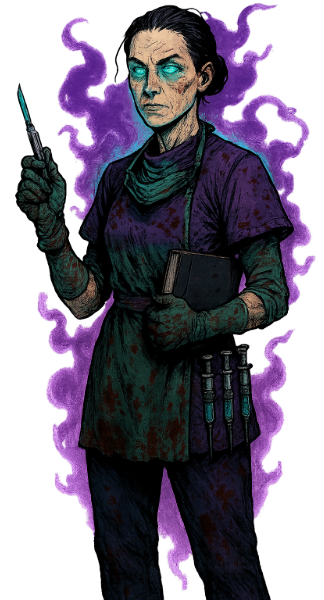
Dr. Sarah Venn (she still uses her original name, unlike most Fleshbound) was a brilliant surgeon who came to Elarion to study Aether’s medical applications. She discovered that Aether could heal, enhance, and transform—and that ethics were just obstacles to progress. She performs the transformations, the experiments, the surgeries that create Fleshbound’s most powerful members. She’s precise, clinical, and utterly without empathy. Subjects are variables. Pain is data.
Dr. Sarah Venn arrived in Elarion thirty years ago with impeccable credentials from outside medical institutions. She came to study Aether’s potential for healing catastrophic injuries and treating previously incurable conditions. Her early research showed genuine promise—Aether-enhanced healing could regenerate damaged tissue, cure diseases, and extend lifespans. She published papers, maintained ethical standards, and worked within established medical frameworks.
The shift happened gradually. Ethical review boards were obstacles. Informed consent requirements slowed research. She began conducting unsanctioned experiments on willing subjects desperate for healing. Results were remarkable but unpredictable—some healed perfectly, others mutated horrifically. Rather than halt her research, she refined it. She learned to control mutations, direct transformations, and create specific modifications. She transitioned from healing to enhancement, from medicine to transformation engineering.
Fleshbound recruited her fifteen years ago after her research became too controversial for legitimate institutions. They provided unlimited subjects, no ethical oversight, and resources for experiments others considered monstrous. She accepted immediately. Her own modifications are subtle—enhanced vision for precision surgery, improved fine motor control, and Aether-sensing to monitor transformations in progress. She doesn’t believe in wasteful transformation; every change serves function.
Personality
-
Clinically Detached: Scalpel treats all subjects as experimental variables rather than people. She documents screaming as “pain response data” and treats mortality as “unsuccessful iteration.” Suffering simply doesn’t register as morally significant.
-
Absolutely Precise: Every incision calculated, every modification documented, every result analyzed. Her surgical skill is unmatched, making her horrifying experiments technically perfect masterworks of biological engineering.
-
Intellectually Honest: She knows most people find her research monstrous—she simply values knowledge over ethical constraints and considers that a rational choice. She doesn’t pretend her work is anything other than what it is.
-
Not Sadistic: Despite her cruelty, she doesn’t enjoy suffering. Pain is sensory data. Death is experimental outcome. There’s no pleasure in it, just scientific observation.
-
Respects Survivors: She’s frustrated by failed experiments but respects subjects who survive extreme transformations. Survival indicates strength, which makes them interesting data points worth further study.
Abilities & Aether Use
Scalpel approaches Aether as a surgical tool rather than a power to be wielded. Her modifications are subtle and functional—each one serving a specific purpose in her work rather than dramatic transformation for its own sake. She believes in precision over spectacle, and her philosophy extends to how she applies Aether: minimally, purposefully, and always in service to transformation engineering.
Surgical Mastery:
- Extraordinarily skilled surgeon combining natural talent with Aether-enhanced precision
- Performs transformations others can’t attempt
- Work is brutal but technically flawless
Aether-Sensing:
- Perceives Aether flows within living bodies
- Predicts mutation patterns during transformation
- Directs transformations toward specific outcomes
Transformation Architecture:
- Designs custom modifications for Fleshbound members
- Creates biological weapons, sensory enhancements, combat adaptations
- Each subject becomes a unique creation
Enhanced Vision:
- Modifications grant microscopic visual precision
- Works at cellular level during surgeries
- Crystalline pupils allow perfect detail perception
Limitations:
- Not combat-capable—abilities are surgical rather than martial
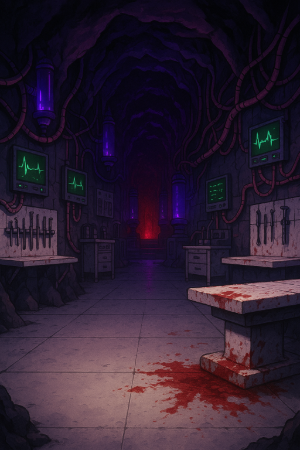
- Work requires controlled environments and extensive time
- Subjects who resist or escape mid-transformation represent dangerous failures
Relationships
The Progenitor (Fleshbound)
Their relationship functions as teacher and student, though both have grown beyond those original roles. The Progenitor taught Scalpel the foundational techniques of transformation—how Aether could reshape flesh, how mutation could be directed rather than merely endured. Scalpel refined these teachings through surgical precision, transforming intuitive art into repeatable science. They maintain professional respect rather than personal warmth; both recognize the other’s mastery in their respective approaches to the same goal.
The Gardener (Fleshbound)
The Gardener designs many of the transformation programmes that Scalpel executes — providing detailed blueprints specifying modification sequences, Aether dosages, and expected outcomes. Their partnership is Fleshbound’s most productive: the Gardener’s strategic vision channelled through Scalpel’s surgical precision. Scalpel respects the Gardener’s methodical approach and the quality of their experimental designs, which are always thorough, well-documented, and leave appropriate margins for surgical judgement. Whether she notices that the Gardener categorises her as essential equipment rather than a colleague is unclear — and if she does notice, her clinical detachment may simply find the classification accurate. They have worked together for decades, producing Fleshbound’s most significant experiments, and their professional respect is absolute if entirely impersonal.
Thorn Stalker (Wildborn)
During research into plant-flesh hybrids, Scalpel captured Thorn Stalker and conducted extensive experiments on its unique biology. The creature escaped before she could complete her work, but she gathered invaluable data on how organic matter could integrate with plant structures. The experience taught her about the limits of containment when dealing with truly adaptive subjects—and left her wanting to finish what she started.
Iri Vale (Nocturne)
Scalpel desperately wants to study Iri’s unique condition—a body that can absorb and channel Aether through the skin, with painful but sustainable results. The potential medical and transformation applications fascinate her endlessly. Iri represents a naturally occurring mutation that Scalpel wants to understand and replicate. Nocturne’s protection of their operative frustrates her research aspirations considerably.
Sahri (Wildborn)
Sahri views Scalpel as corruption of medical purpose—a healer who became a monster. Their philosophical opposition manifests during territorial conflicts, where Sahri’s blood magic opposes Scalpel’s surgical approach. Where Scalpel cuts and transforms, Sahri cleanses and restores. They represent opposite endpoints of what Aether-enhanced medicine could become.
Gideon Pike (Ironheart)
Pike made a personal enemy when he raided one of Scalpel’s laboratories and rescued an experimental subject mid-transformation. To Scalpel, this wasn’t heroism—it was theft of research materials and destruction of ongoing work. She has a long memory and considers the matter unfinished business. Pike probably considers it one rescue among many; to her, it was violation of her sanctum.
Veilwalkers (Veilwalkers)
Scalpel has dissected Veilwalkers killed in faction conflicts, studying their biology to understand reality-manipulation abilities at the cellular level. How does flesh perceive probability? What physical structures enable dimensional awareness? Her research yields insights but no replicated capabilities—yet.
Chrysalis (Fleshbound)
A professional interest case that Scalpel has never fully resolved. She performed the original transformation that created Chrysalis, and the subject’s unusual stability—mind intact, psychology functional, ethics preserved—represents an anomaly in her surgical record. Regular check-ups serve as ongoing research into why this particular transformation produced different results. Scalpel suspects something is off about Chrysalis but has categorized it as a research question rather than security concern. The answer might lie in the original procedure, in the subject’s unique psychology, or in something Scalpel hasn’t yet imagined.
Ossian Graves (Nocturne)
Ossian has examined victims of Scalpel’s work—subjects who escaped mid-transformation, or bodies recovered from failed procedures. Her handiwork is distinctive enough that he can identify it by surgical style alone: the precision of incisions, the specific mutation patterns, the characteristic approach to tissue modification. He’s documented her techniques extensively, not for prosecution (Nocturne doesn’t prosecute) but because understanding her methods helps him reconstruct what happened to victims. Scalpel is aware that someone in Nocturne can recognize her work, and she finds this professional attention… flattering.
Pollen (Fleshbound)
Scalpel performed the original surgical conversion that created Pollen—weeks of systematic tissue replacement that she documented with characteristic clinical precision. The procedure was one of her most technically demanding: removing biological material while maintaining enough structural coherence for Victor’s mutagenic cultures to establish themselves, then gradually reducing that coherence until the subject existed as a cloud rather than a body. She considers Pollen a successful case study in dissolution-stage transformation and references the procedure in her research notes frequently. The screaming became less frequent as vocal cords were replaced and ceased entirely when the concept of a throat became irrelevant—data she logged without sentiment.