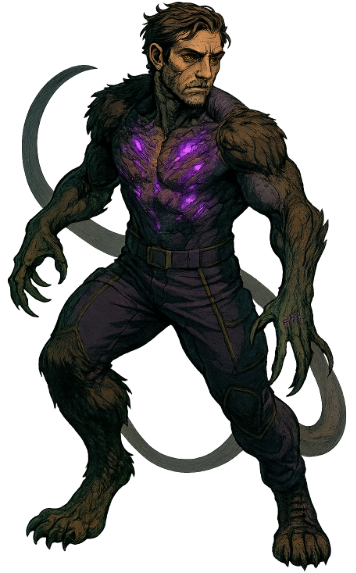
Atlas Chimera
Living experiment who bears eight different species; unity through amalgamation.
Atlas Chimera
Faction: Fleshbound
Age: 31
Origin: Elarion native
Role: Multi-species amalgamation and living proof of transformation philosophy
Overview
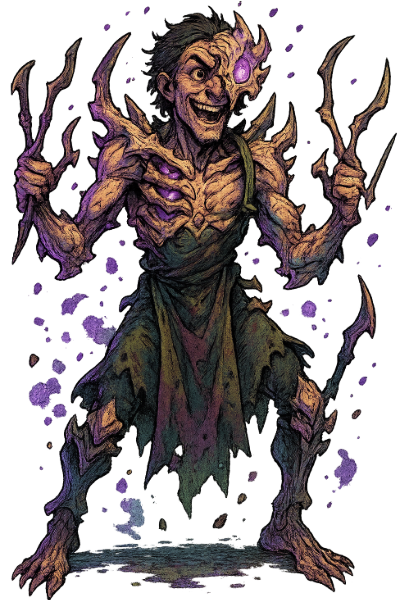
Atlas Chimera bears eight different species. His body is a composite—human cognition in a framework incorporating wolf musculature, eagle vision, snake flexibility, bear strength, cat reflexes, shark regeneration, octopus adaptability, and crystalline Aether integration. He’s Fleshbound’s ultimate experiment, proof that biological boundaries are suggestions rather than limits. He embodies their philosophy: unity through amalgamation, strength through diversity, evolution through deliberate design.
Atlas was born as Marcus Chen in Year 69, an ordinary human living in the Median. At twenty-three, he volunteered for Fleshbound’s experimental multi-species integration program, believing transformation could elevate humanity beyond its limited biological inheritance. The transformation took three years of continuous procedures. Victor Splice edited his genetics to accept foreign DNA. Scalpel performed dozens of surgeries integrating new organs and systems. Cressida Marrow restructured his skeleton to support eight species’ anatomical requirements. Nyx Bloom cultivated specialized organs combining multiple species’ capabilities. The Progenitor supervised, ensuring modifications remained stable despite their impossibility.
What emerged was Atlas Chimera—barely recognizable as human but functionally superior in nearly every measurable way. He could run like wolves, see like eagles, move like snakes, strike like bears, react like cats, heal like sharks, adapt like octopuses, and channel Aether like crystalline formations. For eight years, he’s served as Fleshbound’s living advertisement. He’s proof their methods work, that human biology can be completely rewritten while maintaining consciousness and identity. He’s also constant reminder of what transformation costs—he’ll never be fully human again, never be accepted outside Fleshbound, never have relationships with people who don’t see him as monster or experiment.
Personality
-
Philosophical: Atlas constantly questions what defines humanity after losing physical humanity. He grapples with identity, purpose, and whether consciousness alone makes someone human.
-
Proud: He views his transformation as evolution rather than loss. He chose this path, and he refuses to let others define it as tragedy when he sees it as transcendence.
-
Isolated: Despite Fleshbound community, he struggles with profound loneliness. No one else shares his exact experience—he’s unique in ways that prevent true understanding.
-
Protective: He’s fiercely defensive of Fleshbound and transformation philosophy. Attacks on the faction feel personal because they’re attacks on the choices that made him.
-
Conflicted: Deep down, he questions whether his volunteering was genuine choice or manipulation. Was he truly informed? Did he understand what he was sacrificing?
Atlas speaks about his transformation with pride mixed with melancholy. He believes he’s superior to baseline humans physically but wonders if he’s lost something essential. He’s living embodiment of Fleshbound’s promise and its price. He serves as both soldier and symbol—demonstrating capabilities in combat while representing transformation’s possibilities in propaganda.
Abilities & Aether Use
Atlas Chimera is permanently dependent on Aether to survive. Without constant Aether intake, his eight species’ biology begins destabilizing painfully—systems competing for resources that aren’t there. He consumes massive amounts to maintain the impossible biological harmony within his body. His relationship with Aether isn’t philosophical; it’s existential. He needs it the way others need air.
Multi-Species Capabilities:
- Wolf musculature provides enhanced strength, endurance, and pack coordination instincts
- Eagle vision grants extraordinary eyesight including distance perception and Aether visualization
- Snake flexibility allows unusual range of motion and constriction capabilities
- Bear strength delivers massive physical power for his size
- Cat reflexes provide supernatural reaction time and balance
- Shark regeneration enables rapid healing from normally fatal injuries
- Octopus adaptability allows body configuration changes for different situations
- Crystalline Aether integration permits direct Aether channeling
Combat Proficiency:
- Combines eight species’ natural combat approaches into unique fighting style
- Enhanced senses perceive threats beyond human capability
- Heals during combat from all but catastrophic injuries
- Functions effectively in diverse environmental conditions
- Appearance alone prevents many conflicts through intimidation
Limitations:
- Requires massive Aether consumption to maintain eight metabolisms
- Internal stress from competing biological systems
- Cannot reproduce—genetics too chaotic for viable offspring
- Extremely conspicuous—cannot move unnoticed anywhere
- Psychological burden of being constantly studied and analyzed
- Deep loneliness from being unique—no one shares his experience
Relationships
The Progenitor (Fleshbound)
The Progenitor views Atlas as their greatest success and continues studying him years after the transformation completed. Atlas respects them—how could he not respect his creator?—but struggles with being treated as experiment rather than person. Every conversation contains observation, every interaction yields data. He wonders if the Progenitor sees him at all, or only sees what he represents.
Victor Splice (Fleshbound)
Victor is the genetic engineer who made Atlas’s transformation possible, editing his DNA to accept eight species’ foreign genetic material. Victor views him with pride, calling him “my greatest work.” Atlas appreciates the expertise that created him but dislikes being called a “work”—the language of objects rather than people.
Scalpel (Fleshbound)
Scalpel performed most of Atlas’s transformation surgeries—dozens of procedures over three years. She sees him professionally, as successful outcome of difficult work. He sees her as having literally built his current body with her hands. The relationship contains complex mixture of gratitude and resentment; she created him but also cut him apart repeatedly to do so.
Nyx Bloom (Fleshbound)
Nyx cultivated multiple organs for Atlas’s transformation, growing specialized tissues that combined multiple species’ capabilities. She’s one of the few Fleshbound who treats him as person rather than project. He’s genuinely grateful for her compassion amid the clinical detachment of everyone else involved in his creation.
Cressida Marrow (Fleshbound)
Cressida integrated eight skeletal systems into Atlas’s framework—an achievement of bone-work that still amazes her. When she listens to his skeleton, it overwhelms her senses—multiple bone structures creating complex harmony she’s never encountered elsewhere. He finds her auditory perception fascinating, and she finds his internal architecture beautiful.
Kor Emmer (Wildborn)
Atlas and Kor share mutual recognition as transformed beings, though their paths differed completely. Kor achieved transformation through natural Sprawl exposure; Atlas through deliberate design. They’ve met once and held long conversation about what humanity means when form changes. Despite different paths and opposing factions, they understand each other in ways few others can.
Edda Brann (Ironheart)
Edda views Atlas as victim of Fleshbound exploitation regardless of his claimed voluntary status. She sees someone manipulated into irreversible transformation, used as propaganda, and now dependent on his captors. He views her pity as insulting—he made his choice, and refusing to respect that choice denies his agency. Their encounters are tense.
Magnus Crane (Ironheart)
Magnus witnessed part of Atlas’s transformation process and swore Fleshbound would never take his crews alive afterward. Magnus views Atlas as warning about what Fleshbound does to people; Atlas views Magnus as shortsighted, unable to see transformation as anything but horror. The disconnect reflects their factions’ incompatible philosophies.