
Chrysalis
Failed experiment who retained her mind; secretly aids captured subjects in escaping while pretending loyalty to the Progenitor.
Chrysalis - “The Hidden Mercy”
Faction: Fleshbound
Age: 29
Origin: Elarion native
Role: Failed experiment turned secret liberator
Overview
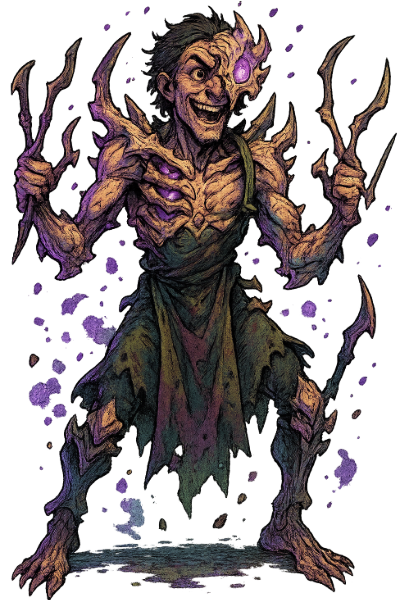
Chrysalis was meant to be Fleshbound’s perfect infiltrator—a subject who could pass as human while harboring monstrous capabilities beneath her skin. The surgical modifications and Aether saturation were successful; her mind was supposed to break along with her humanity. Instead, she retained her consciousness, her ethics, and her horror at what she had become. Now she plays the role of loyal Fleshbound operative while secretly helping captured subjects escape before they can be transformed.
Born in Year 71 as Sera Moss—no relation to the Wildborn Theron Moss—she was a nurse who worked in the Median, treating the sick and injured without regard for faction affiliation. When Silvertongue sold her to Fleshbound in Year 94 as payment for a weapons contract, she expected to die on Scalpel’s operating table. Instead, she woke transformed, her body reshaped into something between human and monster, her mind intact when it should have shattered.
The Progenitor considered her a failure—what use is an infiltrator who retains the capacity for guilt? But Chrysalis proved useful in other ways: calming other subjects before transformation, explaining procedures, serving as proof that the process could produce stable results. She was given limited freedom within Fleshbound territory, enough to serve her true purpose.
For five years, she has used that freedom to help prisoners escape. She can’t save everyone—most are too far gone or too closely watched—but she smuggles out perhaps one in ten before transformation becomes irreversible. She maintains contacts with Nocturne and Veilwalker operatives who receive the escapees, never revealing her identity, never taking credit. If Fleshbound ever discovers her treason, she knows exactly what they’ll do to her.
Personality
- Compassionate: Her nursing instincts survived transformation, driving her to help the suffering despite personal risk.
- Haunted: She lives among monsters while pretending to be one, carrying guilt for those she cannot save and horror at what she’s become.
- Patient: Successful rescue operations require waiting for the right moment; she has learned that rushing costs lives.
- Pragmatic: She cannot save everyone and has made peace with that reality, focusing on those she can reach rather than mourning those she cannot.
- Fractured: Playing the loyal Fleshbound operative requires suppressing her true self constantly, creating psychological strain that grows heavier each year.
Abilities & Aether Use
Chrysalis’s transformation was meant to create a combat-capable infiltrator. Her body contains modifications that allow her to appear human while harboring weapons beneath her skin. Unlike most Fleshbound, she didn’t choose these changes—they were forced upon her, and she uses them reluctantly, only when necessary to maintain cover or protect escapees.
Adaptive Physiology:
- Can suppress visible mutations to appear fully human for extended periods
- Hidden biological weapons can be deployed when needed—retractable bone blades, toxic secretions
- Enhanced strength and resilience beyond human norms
- Accelerated healing when consuming Aether-saturated materials
Human Facade:
- Maintains normal human appearance through conscious effort
- Can pass medical scans if the examiner isn’t specifically looking for modifications
- Voice, mannerisms, and bearing remain unchanged from her pre-transformation self
- Only reveals her true form when absolutely necessary
Medical Knowledge:
- Retains all nursing training from before transformation
- Understands Fleshbound surgical procedures intimately from observing them
- Can partially reverse early-stage transformations in rescued subjects
- Knows which subjects can be saved and which are beyond help
Limitations:
- Suppressing mutations is mentally exhausting; she must rest in true form regularly
- Using her combat capabilities risks revealing her nature to other factions
- Genuine Fleshbound can sense something “wrong” about her if they examine closely
- Her conscience prevents her from participating fully in Fleshbound operations
- If discovered, she has no escape route—she knows too much to be allowed to live
Relationships
The Progenitor (Fleshbound)
The Progenitor views Chrysalis as a failed experiment kept around for utility rather than potential. She maintains careful deference, performing loyalty while hiding her revulsion. The Progenitor occasionally studies her, trying to understand why her mind remained intact when others shattered. She fears these examinations will eventually reveal her true nature.
Scalpel (Fleshbound)
The surgeon who transformed her remains professionally interested in her unusual stability. Chrysalis must endure regular “check-ups” that are actually research sessions, submitting to examination while hiding her hatred. Scalpel suspects something is off but hasn’t identified what—she’s filed Chrysalis’s oddity as a research question rather than a security concern.
The Gardener (Fleshbound)
Chrysalis has interacted with the Gardener only in passing — a calm, white-coated figure who observes from doorways, makes notes in leather-bound files, and speaks with the measured cadence of someone delivering a lecture. She finds them less immediately threatening than the Progenitor or Scalpel, which is precisely what makes them more dangerous. Unlike the others, the Gardener’s attention feels patient rather than predatory — they watch her the way one watches a long-term experiment, with interest rather than urgency. What Chrysalis doesn’t know is that the Gardener has identified her pattern of helping subjects escape and has deliberately chosen to permit it, classifying her as a long-term observation specimen. If she ever discovers that her rebellion has been observed, documented, and factored into someone’s research programme, the psychological devastation would be considerable.
Catalyst (Fleshbound)
Catalyst genuinely believes in Fleshbound philosophy and has tried to “help” Chrysalis embrace her transformation fully. These conversations are torture for Chrysalis, who must fake appreciation while suppressing revulsion. She pities Catalyst for finding meaning in something so monstrous.
Nyx Bloom (Fleshbound)
A complicated relationship with the organ cultivator. Nyx’s work horrifies Chrysalis, but Nyx herself seems almost innocent—focused on creation rather than destruction. Chrysalis has occasionally directed escapees through Nyx’s greenhouses, exploiting her single-minded focus on cultivation.
Kade Moros (Nocturne)
Kade receives escapees through intermediaries, never meeting Chrysalis directly. He knows only that a source within Fleshbound occasionally delivers frightened refugees to Night Market contacts. He’s curious about the source’s identity but respects their operational security—anyone inside Fleshbound territory is playing a dangerous game.
Luna Veil (Veilwalkers)
Luna has treated several escapees for psychological trauma, never knowing who rescued them. She’s pieced together that someone within Fleshbound is helping subjects escape, but hasn’t identified Chrysalis. She desperately wants to contact this unknown ally but fears compromising their position.
Victor Splice (Fleshbound)
Victor finds Chrysalis’s psychological stability fascinating and has requested permission to study her neural structure—a request The Progenitor has so far denied. Chrysalis avoids him carefully, knowing that his examinations would be far more thorough than Scalpel’s check-ups.
Pollen (Fleshbound)
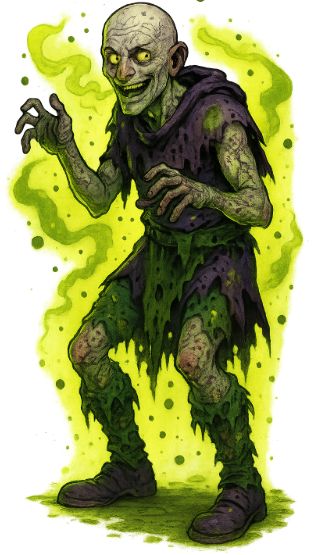
Chrysalis watches Pollen drift through Fleshbound corridors and sees exactly what the Progenitor intends for all of them—complete dissolution of the self. Where Chrysalis retained her mind and her horror, Pollen lost everything. There is nothing left to save, no consciousness to smuggle to safety, no person behind the cloud to reach. Pollen represents the version of her fate that the Progenitor originally intended: transformation so complete that the subject’s identity becomes irrelevant. She finds herself unable to look at Pollen without imagining her own face dissolving into spores, which makes the drifting cloud one of the most effective reminders of why she continues her secret work—and what happens to those she fails to rescue in time.