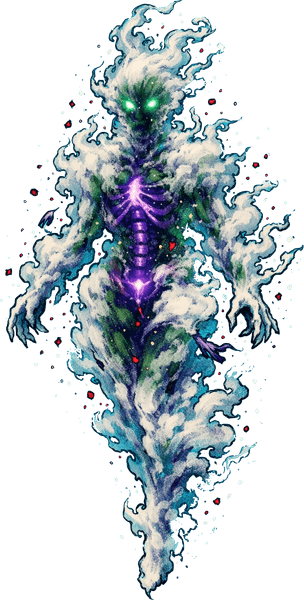
Pollen - “The Mutagenic Drift”
Faction: Fleshbound
Age: Unknown (pre-transformation identity erased)
Origin: Unknown (subject records deliberately destroyed)
Role: Aerosol bioweapon and area-denial organism
Overview
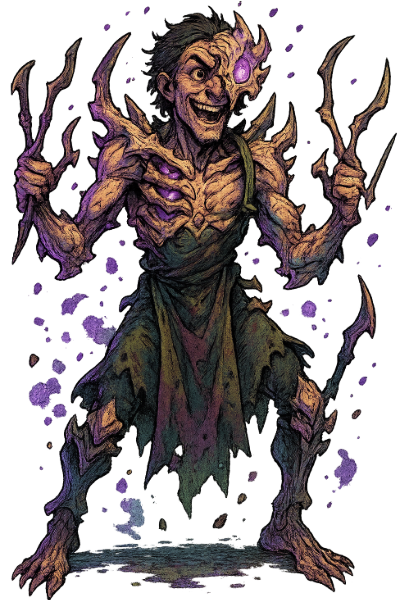
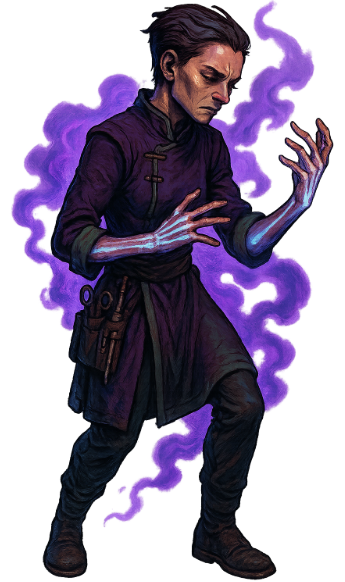
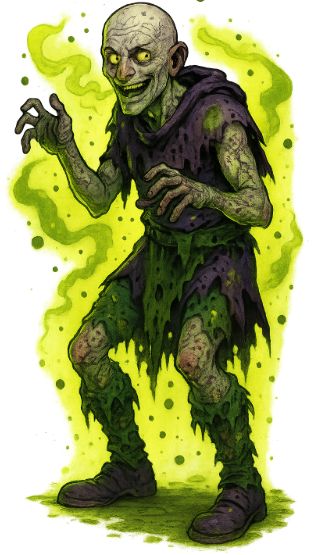
Pollen is less a person and more a phenomenon. Once human, they have been so thoroughly transformed by Fleshbound’s mutagenic programme that they exist as a drifting cloud of spore-laden vapour barely holding a humanoid shape. They don’t fight in the traditional sense—they simply exist near their opponents, and the mutagenic spores do the rest. Proximity to Pollen weakens Aether channelling, corrupts biological processes, and introduces mutations in anything organic. They are Fleshbound’s answer to a question no one else thought to ask: what happens when you make the weapon and the delivery system the same thing?
The Progenitor had been developing aerosol-dispersal organisms for years—biological weapons that could spread transformation without requiring surgical contact. Most subjects died during conversion. Those that survived remained too solid, too individual, too human to serve as effective vectors. Pollen was different. The subject—whose name, gender, and history were deliberately purged from Fleshbound records after conversion—was selected for an unusual compatibility with Aether-saturated fungal compounds. Victor Splice engineered the spore-production mechanism at the cellular level, replacing conventional biology with self-replicating mutagenic cultures. Scalpel performed the original surgical conversion over a period of weeks, systematically replacing tissue with spore-producing structures until the boundary between host and infection ceased to exist.
The result exceeded expectations. Where previous aerosol subjects retained too much physical coherence, Pollen dissolved. Their body became a loose aggregate of mutagenic material held together by residual Aether patterns—a drifting cloud that could pass through ventilation systems, seep under doors, and contaminate entire districts simply by existing. The Progenitor considered them one of Fleshbound’s most successful experiments: a weapon that doesn’t need to be aimed.
When the Sevenfold emerged in late March—bringing their faith-based Aether manipulation and divine authority into Elarion’s power landscape—the Progenitor accelerated Pollen’s deployment. Faith is just another biological process. Devotion is just another chemical reaction. And Pollen was designed to infect anything organic, including whatever passes for conviction.
Personality
- Swarm-Logic: Pollen doesn’t think in individual thoughts but in distributed biological patterns—stimulus, response, dispersal. What passes for decision-making is closer to how a fungal colony navigates toward nutrients than how a person weighs options.
- Residual Echo: Beneath the swarm-logic, fragmentary traces of the original person surface unpredictably—a moment of hesitation before drifting toward a child, a pattern in the spore cloud that resembles a hand reaching out, a sound that could almost be a word. These echoes are becoming rarer.
- Eerie Serenity: Pollen moves through the world with a dreamlike calm that observers find deeply unsettling. There is no aggression, no malice, no urgency. The spores simply drift. The corruption simply happens. This absence of intent makes them more frightening than any deliberate predator.
- Compulsive Dispersal: Whatever consciousness remains is oriented entirely toward spreading—not with purpose or desire, but the way a plant orients toward light. Pollen drifts toward concentrations of organic life and Aether because that is what their biology demands.
- Beautiful Horror: There is something genuinely, disturbingly lovely about Pollen in motion—bioluminescent particles catching light, the slow-motion drift of spore clouds, patterns forming and dissolving like aurora. Observers often freeze in fascination before recognising the danger, which is itself a survival mechanism the Progenitor engineered deliberately.
Abilities & Aether Use
Pollen’s relationship with Aether is parasitic and involuntary. Their spore cloud absorbs ambient Aether from the environment and from nearby living organisms, weakening Aether-based abilities in their vicinity. They don’t channel Aether so much as contaminate it—converting clean energy into mutagenic fuel that feeds their dispersal cycle.
Mutagenic Aura:
- Passive spore release corrupts Aether flow in nearby organisms, weakening their ability to channel power
- Organic matter in proximity begins exhibiting mutagenic changes—plants growing wrong, skin discolouring, Aether constructs destabilising
- The weakening effect is indiscriminate; allies and enemies alike are affected unless inoculated by Fleshbound countermeasures
Aerosol Dispersal:
- Body can shift between a loose humanoid shape and near-total diffusion—becoming a cloud that infiltrates enclosed spaces
- Can pass through ventilation systems, under doors, and through any gap larger than a few millimetres
- Reconstitutes into vaguely humanoid form when density is required for movement or interaction
Spore Contamination:
- Surfaces Pollen passes over develop mutagenic fungal growths within hours
- Contaminated areas remain dangerous long after Pollen has drifted elsewhere
- Closed environments become saturated quickly, creating zones that require hazmat-level precautions to enter
Aether Corruption:
- Proximity disrupts Aether channelling in other beings, reducing the effectiveness of Aether-based abilities
- Faith-based and willpower-based Aether manipulation appears equally vulnerable to corruption
- The disruption is biological rather than magical—spores physically interfere with the organic processes that channel Aether
Limitations:
- Strong winds disperse the spore cloud, requiring time to reconstitute
- Fire destroys spore material faster than it can regenerate
- Sealed environments with positive air pressure are effectively impervious
- The weakening effect diminishes with distance—beyond a few metres, contamination becomes negligible
- Cannot communicate or coordinate in any conventional sense; must be directed by handlers or left to drift on biological autopilot
- Ironheart’s sealed armour and filtration systems provide significant resistance
Relationships
The Progenitor (Fleshbound)
Pollen is one of the Progenitor’s proudest achievements—proof that transformation can transcend individual form entirely. Where most Fleshbound experiments create stronger, more durable versions of human biology, Pollen abandoned the concept of a body altogether. The Progenitor considers them the logical endpoint of aerosol-dispersal research: a weapon that infects by existing, that corrupts by proximity, that transforms without touching. They accelerated Pollen’s deployment specifically in response to the Sevenfold’s arrival, reasoning that faith is merely another biological process susceptible to mutagenic intervention. The Progenitor observes Pollen’s drift patterns with the fascination of a scientist watching a successful culture spread across a petri dish—pride in the work, interest in the data, and no concern whatsoever for the consciousness that was consumed to create it.
The Gardener (Fleshbound)
The Gardener designed Pollen’s dispersal strategy — the deployment schedule, contamination vectors, and timing that turned a bioweapon into a coordinated campaign. While Victor built the mechanism and Scalpel performed the conversion, the Gardener determined when, where, and how Pollen would be released to achieve maximum strategic effect. They monitor Pollen’s drift patterns daily through remote telemetry, adjusting deployment schedules with the patience of a farmer managing irrigation. Pollen has no capacity to recognise the Gardener as an architect of their existence — recognition requires consciousness, and Pollen barely has one. But the Gardener regards Pollen with something approaching parental pride: a seed they planted, growing exactly as designed.
Victor Splice (Fleshbound)
Victor engineered the spore-production mechanism that makes Pollen possible. At the cellular level, he rewrote the subject’s biology to replace conventional tissue with self-replicating mutagenic cultures—each cell a tiny factory producing Aether-corrupting spores. He considers Pollen a technical masterwork: the most elegant solution he’s ever designed to the problem of delivering transformation without physical contact. Unlike his work on Spore, which was a proof-of-concept for fungal integration, Pollen was engineered from the ground up as a deployment system. Victor monitors Pollen’s spore output remotely through biological telemetry he embedded during conversion, treating the data as ongoing research rather than the activity of a former person.
Scalpel (Fleshbound)
Scalpel performed the original surgical conversion that created Pollen—weeks of systematic tissue replacement that she documented with characteristic clinical precision. The procedure was one of her most technically demanding: removing biological material while maintaining enough structural coherence for the mutagenic cultures to establish themselves, then gradually reducing that coherence until the subject existed as a cloud rather than a body. She considers Pollen a successful case study in dissolution-stage transformation and references the procedure in her research notes. The subject’s screaming during the process was logged as “vocalisation intensity data” in her files, becoming less frequent as vocal cords were replaced and finally ceasing entirely when the concept of a throat became irrelevant.
Chrysalis (Fleshbound)
Chrysalis watches Pollen drift through Fleshbound corridors and sees exactly what the Progenitor intends for all of them—complete dissolution of the self. Where Chrysalis retained her mind and her horror, Pollen lost everything. There is nothing left to save. No consciousness to smuggle to safety, no person behind the cloud to reach. For Chrysalis, Pollen represents the version of her fate that the Progenitor originally intended: transformation so complete that the subject’s identity becomes irrelevant. She finds herself unable to look at Pollen without imagining her own face dissolving into spores, which makes the drifting cloud one of the most effective reminders of why she continues her secret work—and what happens to those she fails to rescue in time.
Spore (Fleshbound - Escaped)
Pollen and Spore are two answers to the same question: can Fleshbound create a living infection? But the answers diverge completely. Spore was an early experiment—fungal integration that succeeded biologically but failed strategically, producing a being that retained consciousness, loneliness, and the desperate desire to escape. Pollen was the refined version: purpose-built, consciousness stripped away, designed from the ground up as a deployment system rather than a person. If Spore ever learned of Pollen’s existence, they would recognise a dark mirror—what Victor might have made them if the programme had progressed further. Pollen, for their part, cannot recognise Spore at all. Recognition requires a mind, and Pollen barely has one.
Vera Cask (Ironheart)
Pollen has no capacity to recognise Vera Cask as an individual threat—recognition requires consciousness, and Pollen barely has one. But the Ironheart demolitions specialist represents something Pollen’s swarm-logic can perceive: resistance. Sealed corridors, quarantine barriers, atmospheric filtration systems running at maximum—Vera’s containment protocols create dead zones in the air where Pollen’s spores cannot drift. For the first time since deployment, something is pushing back against the spread, and Pollen’s biological autopilot routes around Vera’s containment lines the way water routes around a dam. Whether this constitutes awareness of an enemy or merely stimulus-response to environmental obstacles is a question only the Progenitor finds interesting.