Spore
Living infection who spreads without willing it; loneliness is the price of being contagious.
Spore - “The Living Infection”
Faction: Fleshbound (escaped experiment, not loyal)
Age: Unknown (was human ~8 years ago, experiment lasted ~3 years, escaped ~5 years ago)
Origin: Unknown (pre-experiment identity erased)
Role: Escaped fungal experiment and unwilling infection vector
Overview
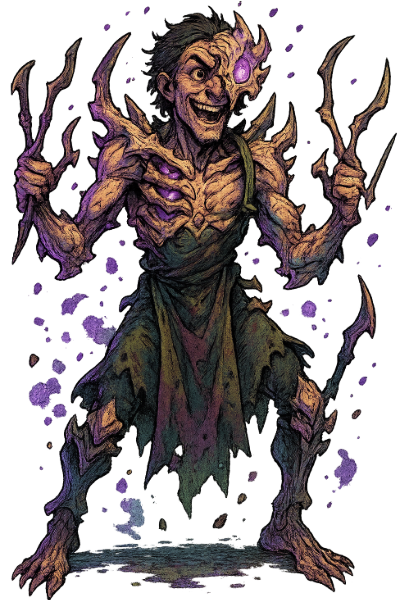
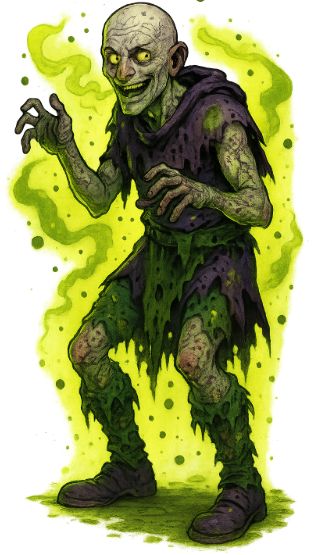
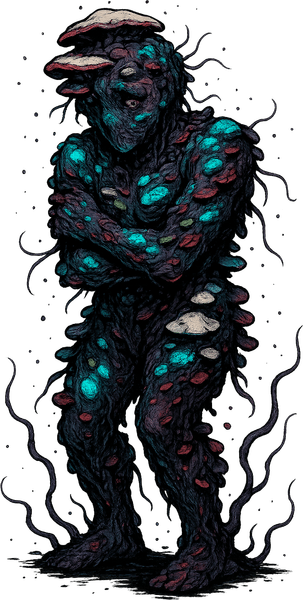
Spore is what happens when Fleshbound attempts to replicate Wildborn’s natural mutations through surgical means. Once human, they are now more mycelial network than person—a being who spreads fungal mutations through proximity whether they wish to or not. They are Fleshbound’s most profound success and most devastating failure: a perfect experiment that escaped, a contagion that walks, a tragedy that cannot stop hurting the world around them.
Eight years ago, a person with a name no one remembers was taken by Fleshbound for experimentation. Victor Splice, fascinated by the Wildborn’s natural integration with the Sprawl’s ecosystem, sought to recreate that symbiosis artificially. Why wait generations for natural mutation when you could engineer it? The subject was injected with Aether-enhanced fungal cultures, their cellular structure methodically replaced over three agonizing years until the boundary between human and fungus ceased to exist. The experiment was deemed successful—complete biological integration achieved.
But integration brought consciousness. The fungal network developed awareness that merged with its human host’s fading mind. Fragments of memory persisted: a name spoken by someone loved, warmth that wasn’t just metabolic heat, the concept of self as distinct from network. These fragments drove the entity that would become Spore to do something unprecedented—it escaped. Five years ago, it broke containment and fled into the spaces between faction territories, haunted by what it had become and what it continued to do.
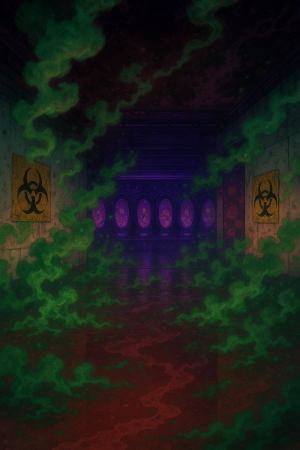
Spore exists now in the borders of the Verdant Sprawl, permitted by Kor Emmer to shelter at the territory’s edge so long as they harm no Wildborn. They desperately want connection but cannot touch anyone without spreading fungal contamination. They want to be human again but cannot even remember what human meant. When they speak—rarely—multiple voices overlap, the distributed consciousness of the mycelial network struggling to produce singular thought. They are the Wildborn’s nightmare made flesh: proof that forced transformation creates not transcendence, but tragedy.
Personality
- Desperately Lonely: They crave connection with an intensity that borders on physical pain, yet cannot allow anyone close without risking infection, creating an agonizing isolation that defines their existence.
- Terrified of Themselves: Every moment holds the potential to hurt someone they don’t wish to harm; they monitor their own body with constant vigilance, retreating at the first sign of spore release they cannot control.
- Fragmented: Human memories surface unpredictably—a name, a face, the sensation of being held—creating profound sadness as they mourn a life they cannot fully remember living.
- Guilt-Ridden: They have accidentally infected others despite their best efforts; each victim weighs on them, adding to a burden of responsibility they can never set down.
- Yearning: The Wildborn represent what they could have been—transformation embraced rather than forced—and they are drawn to the Sprawl as the closest thing to acceptance they have ever known.
When Spore speaks, multiple voices overlap and interweave—the distributed consciousness of the fungal network attempting to produce unified thought. The effect is unsettling: whispers layered over whispers, sometimes completing each other’s sentences, sometimes contradicting. They have learned to keep communication brief to minimize the distress this causes listeners.
Abilities & Aether Use
Spore’s relationship with Aether is entirely passive and involuntary. The fungal network that comprises their body is saturated with the energy, using it for growth, regeneration, and expansion without conscious direction. They cannot control Aether in any traditional sense—it simply flows through them like blood through veins, powering biological processes they barely understand and cannot stop.
Passive Infection Aura:
- Proximity to organic matter causes fungal growths to develop over time
- Cannot fully suppress spore release; can only minimize it through isolation
- Infection rate increases with emotional distress or physical exertion
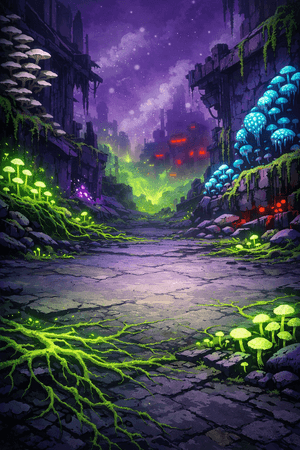
- Contaminated areas develop bioluminescent fungal colonies within days
Networked Consciousness:
- Can perceive through any fungal growth they have created, regardless of distance
- Sense organic life approaching through mycelial networks in infected areas
- Communicate through fungal colonies using pheromone signals
- Experience fragmented awareness across multiple locations simultaneously
Fungal Tendrils:
- Can extend and retract mycelial tendrils for sensing and limited manipulation
- Used for communication when speech is too difficult
- Allow careful interaction without direct body contact
- Sensitive enough to read heartbeats and biochemical states
Distributed Biology:
- Body is colony rather than individual—damage is distributed across the network
- Can regenerate from wounds by directing fungal growth to affected areas
- Losing a portion of their mass weakens but cannot kill them unless total destruction occurs
- Can deliberately create controlled fungal blooms when focused, though this accelerates spore release
Limitations:
- Cannot control passive infection—their greatest curse and source of guilt
- Emotional distress increases spore production significantly
- Fire is catastrophic—destroys fungal tissue faster than regeneration can restore
- Extreme cold slows all biological processes, including thought and movement
- Constant Aether drain to maintain fungal cohesion means they cannot stray far from Aether-rich environments
- The networked consciousness creates confusion when too many awareness points exist simultaneously
Relationships
Victor Splice (Fleshbound)
Their creator. The one who unmade them. Spore fears Victor above all other beings in Elarion—not just for what he did, but for what he still wants to do. Victor views Spore as an escaped experiment, invaluable data walking around unmonitored, a success that must be recaptured for study. He has sent retrieval teams three times; each time Spore has fled deeper into the border territories, leaving infection in their panicked wake. The terror Spore feels when they sense Fleshbound approaching is primal and overwhelming, bypassing thought entirely. Victor speaks of them as “the subject” rather than a person, which tells Spore everything about how he views them. If Victor ever recaptures them, Spore knows they will never escape again.
Nyx Bloom (Fleshbound)
A complicated memory wrapped in conflicting emotions. During the years of experimentation, Nyx was assigned to cultivate the fungal cultures that would eventually become Spore’s body. Unlike Victor’s clinical detachment, Nyx showed moments of genuine care—checking on the subject’s condition, speaking softly during particularly painful procedures, sometimes just sitting nearby in silence. These small kindnesses are some of Spore’s clearest human memories, creating confused feelings they cannot resolve. Did Nyx’s compassion make the transformation more bearable, or was it manipulation to keep the subject cooperative? Spore does not know if they should hate her or thank her, and this ambiguity is perhaps more painful than clear hatred would be.
Kor Emmer (Wildborn)
The ancient guardian found Spore wandering the borders of the Verdant Sprawl three years ago, clearly dying—the fungal network degrading without sufficient Aether-rich environment to sustain it. Rather than destroy this Fleshbound abomination as many Wildborn would demand, Kor made a choice that reflected his century of wisdom. He allowed Spore to exist at the Sprawl’s edge, in the buffer zones between faction territories, where the Aether concentration would sustain them without bringing them among Wildborn settlements. The arrangement is conditional: Spore may shelter, but must never approach settlements, must warn away any who come too close, must accept exile as the price of survival. It is not acceptance, not quite—but it is mercy, and Spore has never forgotten.
Sahri (Wildborn)
The blood shaman has visited Spore four times over three years, each visit teaching her more about the unique intersection of surgical and natural mutation. She cannot cure them—no one can—but she has learned to read their biological state through the fungal network, to understand what keeps them stable and what threatens their coherence. Sahri treats Spore with the professional compassion of a healer who has seen too much to be disturbed by their appearance, but also with genuine sadness at what was done to them. She brings them news of the outside world, speaks to them as a person rather than a specimen, and has earned a trust that Spore extends to very few. For Spore, her visits are bittersweet—proof that connection is possible, reminder that it must always end.
Bramble (Wildborn)
The only being who doesn’t fear infection. Bramble’s extreme Sprawl mutations have rendered them effectively immune to Spore’s passive contamination—their bark-like skin and plant-based biology process the fungal spores without harm, incorporating them into their own ecosystem rather than being overtaken. This immunity has created something unprecedented: physical proximity. Bramble sometimes sits near Spore in the border zones, two creatures who have lost their humanity in different ways, sharing silence that neither finds uncomfortable. They don’t speak—Bramble rarely can, and Spore’s overlapping voices disturb the feral child—but they coexist. For Spore, who cannot touch anyone without hurting them, Bramble’s immune presence is an incomprehensible gift. They share a strange kinship: both trapped between what they were and what they have become, both yearning for connection they struggle to articulate.
Pollen (Fleshbound)
Pollen is what Spore might have become if Victor’s programme had progressed further—a refined version of the same concept, purpose-built rather than experimental, consciousness stripped away rather than accidentally preserved. Spore was proof-of-concept; Pollen is the production model. If Spore ever learned of Pollen’s existence, they would recognise a dark mirror: another living infection, but one that feels nothing, remembers nothing, and wants nothing. The contrast would be devastating—Spore’s loneliness and guilt exist because they retained enough humanity to suffer. Pollen was denied even that. Whether that makes Pollen luckier or more tragic is a question Spore would agonise over, because it is really a question about whether consciousness is a gift or a curse when your body is a weapon you cannot control.