What the Ground Gives Back
Fleshbound deploys Pollen into the Median's air as the Bloom begins
What the Ground Gives Back
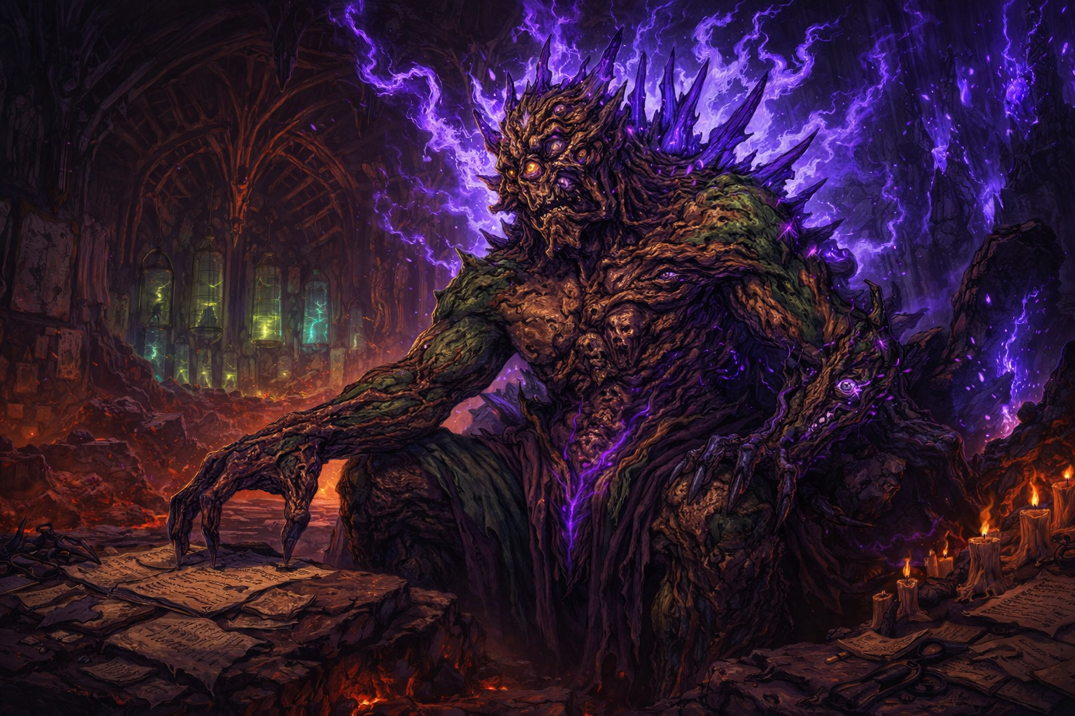
The Progenitor had not moved in three days.
This was unremarkable. The leader of Fleshbound often remained still for extended periods, their massive form settled into the throne chamber’s volcanic rock like another geological feature. Their four visible eyes — two golden, one milky white, one still forming behind a membrane of translucent tissue — tracked across the information spread before them: reports tattooed into stretched skin, data carved into bone tablets, living specimen displays flickering in suspension tanks along the far wall.
The reports described something new.
Sevenfold. A seventh faction. The word tasted strange in the Progenitor’s multiple mouths, and they savoured it the way they savoured all new data — carefully, without rushing to conclusions. The newcomers had emerged from the Median less than a week ago, bringing with them a faith-based approach to Aether manipulation that the existing six factions had never encountered. Some of Elarion’s residents had responded with fear. Others with curiosity. The Progenitor felt neither.
They felt interest.
“A new pollination event,” they murmured. The multiple voices layered over each other — their own bass rumble, and beneath it, softer echoes of those who had been absorbed over decades. One voice almost sounded like it was asking a question. The Progenitor ignored it.
Their crystallised spine pulsed with purple light as they processed the implications. New organisms arriving in an existing ecosystem. New biological patterns to observe. New subjects to study.
New variables to account for.
The Progenitor’s form shifted — bones grinding, muscle relocating, a new eye opening on their left shoulder to examine a specimen tank more closely. They reached out one massive hand, fingers splitting and reforming as they moved, and touched the bone tablet containing Victor’s latest report.
“Accelerate,” they said. The word vibrated through the chamber’s floor, through the volcanic rock, down into the tunnels where Fleshbound worked their art. “The conditions are optimal.”
Three levels below the throne chamber, Victor Splice had already anticipated the order.
His laboratory hummed with the particular frequency of active genetic sequencing — banks of bioluminescent displays casting cyan light across white walls and the sterile equipment of precision science. A DNA double helix rotated lazily in the holographic display above his primary workstation, annotated with modification markers in Fleshbound’s colour-coded system: purple for transformative success, green for stable integration, red for subjects who hadn’t survived the process.
Victor’s display showed almost entirely purple and green.
“Spore output up fourteen per cent since yesterday,” he said to nobody. Speaking aloud while working was a habit he had never bothered to break. He adjusted his goggles and leaned closer to the telemetry readout. The data streamed live, transmitted by biological sensors he’d embedded during the conversion process — each spike and trough a measurement of spore density, mutagenic potency, and dispersal range.
Pollen was performing beautifully.
He tapped a sequence into his console and watched the readout adjust. “Increasing ambient Aether feed to the dispersal corridor. Let’s see if we can push the contamination radius past the thirty-metre threshold.”
On the screen, a blip moved — small, drifting, barely there. Pollen’s position in the ventilation network, tracking upward from the deep labs toward the surface tunnels and, beyond them, the open air of the Median.
Victor watched the blip rise and felt the warm satisfaction of successful engineering. Where Spore had been a proof-of-concept that retained too much consciousness and ultimately escaped, Pollen was the refined product. Elegant. Purpose-built. The most efficient delivery system for mutagenic transformation he had ever designed.
He made a note in his file: Subject performing within optimal parameters. Accelerating deployment per the Progenitor’s directive. Recommend expanding dispersal to second and third ventilation corridors within 48 hours.
He didn’t think about the person Pollen used to be. There was nothing productive in that data.
Pollen drifted.
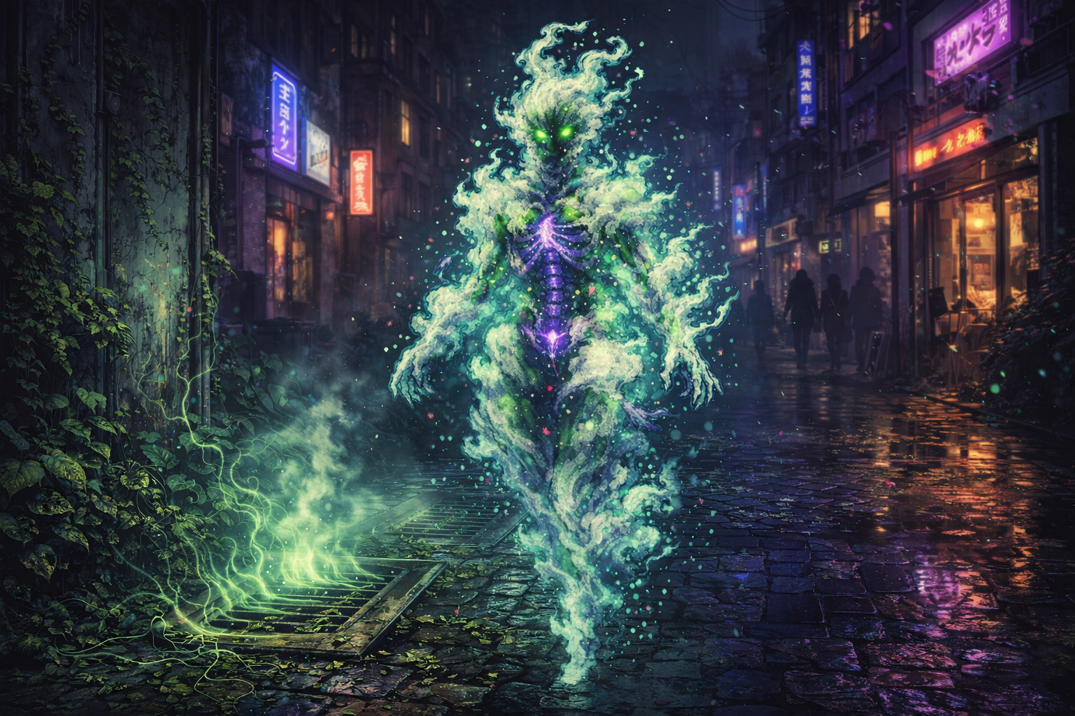
There was no other word for how they moved. Not walking — the concept of legs had become irrelevant months ago. Not floating — that implied weightlessness, and Pollen carried weight, though it was distributed across thousands of particles rather than concentrated in bone and muscle. They simply drifted, the way smoke drifts from a spent match, the way dust moves through a shaft of light.
The ventilation shaft was dark and warm. Pollen’s spore cloud contracted slightly to navigate the narrower passages, the outermost layer of pale particles compressing inward, revealing deeper strata of toxic green and bruise purple. At the cloud’s centre, barely visible, the faint outline of a skeleton served as anchor — the last physical remnant of whoever they had been before the conversion had taken everything else.
Two points of bioluminescent green pulsed where eyes should have been. Slow. Rhythmic. Like breathing, though Pollen no longer breathed.
As the cloud passed through the shaft, the metal walls began to discolour. A faint fuzz of mutagenic growth appeared on the rivets and seams — greenish-white filaments that would keep growing long after Pollen had drifted elsewhere. In the ventilation system behind them, organic filters designed to maintain air quality in the lower labs had already begun to warp, their fibres rearranging into structures that served Pollen’s biology rather than Fleshbound’s infrastructure.
Nobody had instructed Pollen to contaminate the ventilation system. Contamination was simply what happened when Pollen existed near things.
The shaft opened. Air pressure changed. A whisper of wind — surface wind, carrying the chemical signature of the Median’s rain and street-level exhaust — washed over the spore cloud. For a fraction of a moment, the cloud shifted into a shape that almost resembled a hand reaching upward.
Then it dissolved into the open air.
On Rusthaven’s southern monitoring station — a cobbled-together array of pre-Aetherfall atmospheric sensors maintained by Ironheart volunteers — the air quality display flickered amber for the first time in six months.
In the Median’s eastern district, a vendor at a night market stall noticed that the moss growing between his cobblestones had changed colour overnight. It was spreading faster than it should. And the new growth spiralled, which moss did not do.
An Ironheart patrol officer reported that the breathing filters in her sealed helmet were degrading faster than usual. The fibres looked wrong. She filed the report and requisitioned new filters, noting the anomaly without understanding its source.
A street-level informant for Nocturne — one of Kade Moros’s many anonymous data points scattered across the Median — recorded an unusual pattern: three separate reports of skin irritation from residents in the same block, all within the same twelve-hour window. Individually unremarkable. Together, suggestive. The informant filed the data and moved on to other business.
None of them understood what they were seeing. Not yet. The contamination was subtle — a hair’s breadth of change in air composition, a fraction of a degree in temperature, a barely perceptible shift in how organic matter grew. But it was spreading. And it would not stop.
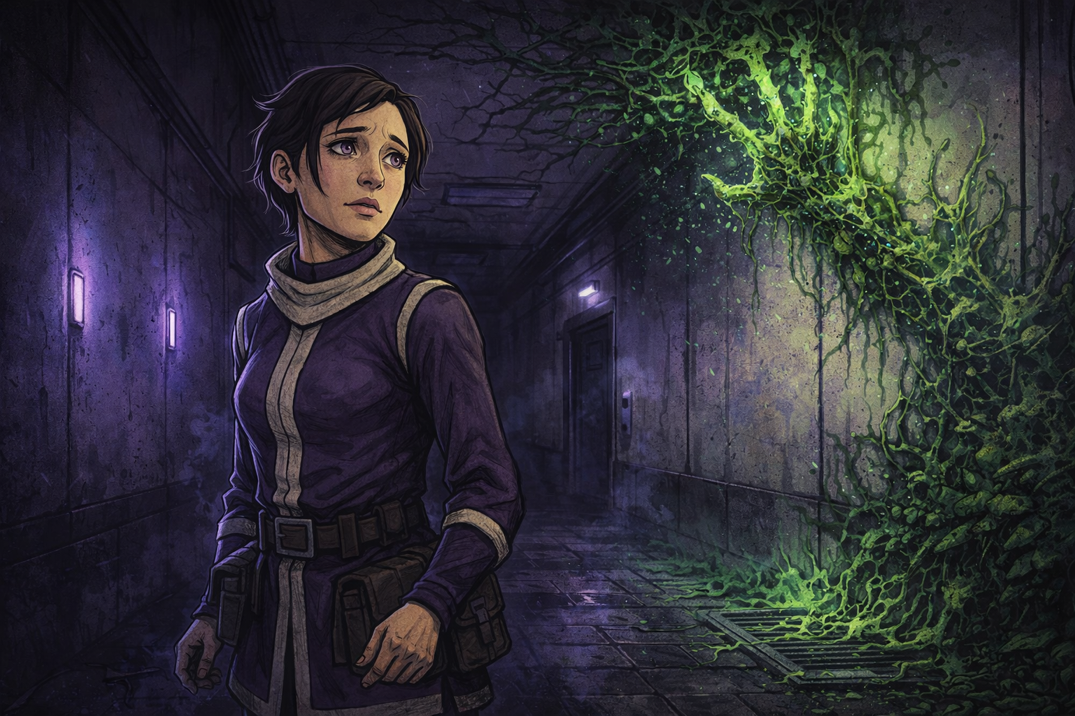
In a corridor between Lab Seven and the subject holding cells, Chrysalis stood very still and watched the last traces of Pollen’s passage dissolve from the air.
The ceiling showed new growth already. Thin filaments of mutagenic material had settled on the surface and begun to colonise, spreading outward from the ventilation grate in a pattern that resembled — if you looked at it the right way, which Chrysalis desperately didn’t want to — a reaching hand.
She had been on her way to the holding cells. Two new subjects had arrived this morning, taken from the Median’s fringes, and she needed to assess whether either of them could be reached before the conversion process began. One in ten. That was her ratio. One in ten subjects she managed to help escape before transformation became irreversible.
But Pollen changed the mathematics.
You couldn’t smuggle someone to safety from something in the air. You couldn’t time a rescue around a weapon that didn’t sleep, didn’t pause, didn’t recognise the difference between a target and a bystander. Pollen was not a procedure that happened in a surgical theatre — it was an atmosphere that happened to everything within range. Chrysalis’s carefully maintained network of escape routes, her contacts in Nocturne, her knowledge of patrol schedules and security gaps — none of it protected anyone from breathing.
She pressed her back against the corridor wall and closed her eyes. Her hidden modifications pulsed beneath her skin — the bone blades, the toxic glands, the enhanced musculature that made her Fleshbound’s failed infiltrator and the surface’s secret mercy. All useless against a cloud.
They’re going to contaminate the entire Median, she thought. Not with soldiers. Not with needles. With air.
When she opened her eyes, the filaments on the ceiling had grown another centimetre. At the far end of the corridor, through the dim purple light of the Scar’s bioluminescence, she could see the entrance to the holding cells. Behind those doors, two people were waiting for someone to save them.
Chrysalis straightened her shoulders and walked toward the door. She could not stop Pollen. She could not prevent the Bloom. But she could still reach the ones in front of her — the ones who still had faces, still had names, still had a chance.
One in ten. And the counting had to start somewhere.
Far below, in the throne chamber, the Progenitor smiled.
It was not a pleasant expression. The overlapping faces shifted, mouths pulling in different directions, some showing teeth that were crystalline and others showing teeth that were still forming. But it was, unmistakably, a smile.
On the bone tablet before them, Victor’s latest telemetry showed Pollen’s position: surface-level, drifting east. The first contamination reports from the Median would reach other factions within days. Ironheart would mobilise first — they always did, predictable in their protectiveness. Then Nocturne would begin selling the information. The Veilwalkers would try to understand it. The Wildborn would feel it in their roots. The Silvertongue would find a way to profit from the panic.
And the Sevenfold — the new variable — would learn their first lesson about Elarion: that faith, however fervent, does not filter the air you breathe.
The Progenitor settled deeper into the volcanic rock, their body crackling and reshaping in the slow rhythm of continuous evolution. They had waited years for this moment. The Gardener had designed every variable. Victor had engineered the mechanism. Scalpel had performed the conversion. And now Pollen was in the wind, and the Bloom was beginning, and every faction in the city would soon feel the ground giving back what Fleshbound had planted in it.
“Beautiful,” the Progenitor murmured. Their voices — all of them — agreed.
Outside, in the darkening streets of the Median, the air tasted faintly of pollen.
Nobody looked up.