The Containment Line
Ironheart dispatches Vera Cask to contain Fleshbound contamination at the Scar border
The Containment Line
The atmospheric sensor on Vera Cask’s wrist beeped amber three hundred metres before she reached the border.
She stopped walking, held the sensor up, and read the display without expression. Mutagenic particulate at twelve parts per million. Biological contaminant markers: positive. Aether corruption index: rising. The readings were worse than the scout report had indicated, which meant either the scouts had lied or the contamination had advanced since they’d filed. Vera assumed the latter. Scouts didn’t lie — they just didn’t know what they were looking at.
She tapped her earpiece. “Vera Cask, Hazmat-Demo, arriving at Scar border checkpoint Theta-7. Scout report says contamination starts at the four-hundred-metre line. It doesn’t. I’m reading mutagenic particulate at three hundred and I haven’t crossed the marker yet.”
Static. Then a voice she didn’t recognise — one of the monitoring station volunteers. “Copy, Cask. We’re logging. Proceed at discretion.”
“Proceeding,” Vera said, and kept walking.
The border between Ironheart’s industrial zones and the Scar was never clean. The Frost Quarter’s brutal cold gave way to the Scar’s volcanic heat in a transition band where frost and ash fought for dominance on every surface. Buildings here showed the scars of both environments — ice damage on the upper floors, heat warping on the lower. The ground was slick with meltwater that never fully froze, tinted orange by rust and something else that Vera’s sensor kept flagging as organic.
She crouched and ran her fingers across a patch of wall near a ventilation outlet. The surface was covered in a thin film of growth — greenish-white filaments that spiralled outward from the vent in patterns that looked almost deliberate. Not moss. Not lichen. Something that grew faster than either and didn’t belong on concrete.
Vera pulled her gas mask up from around her neck and sealed it over her face. The orange filter canisters hummed as they engaged. She’d learned a long time ago that if the wall was growing things, you stopped breathing the air.
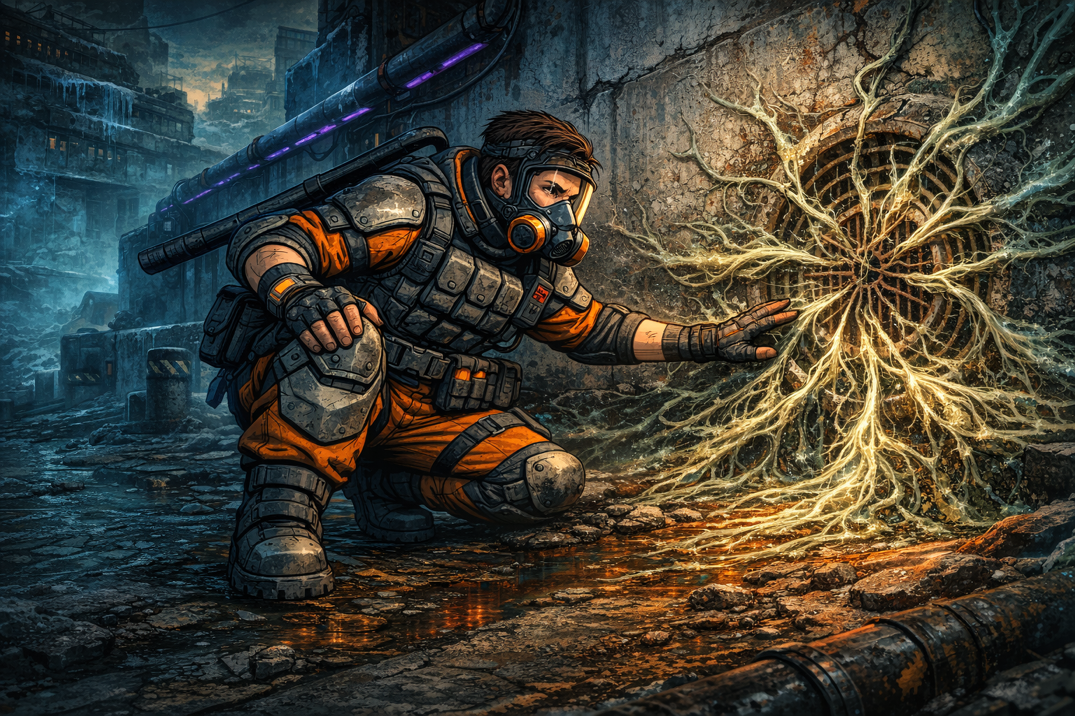
She found the scout’s marker post at four hundred metres — a steel rod driven into the fractured pavement with an orange hazard flag. The flag was wrong. Not the placement, which was competent enough. The fabric. The edge of the flag had developed a faint fuzz of the same greenish-white filaments that covered the ventilation outlet. Mutagenic growth on treated, synthetic fabric. That required either direct contact with contaminated material or prolonged exposure to airborne spores.
The flag had been planted two days ago.
Vera pulled the rod out of the ground, examined it, and dropped it. She didn’t need markers to tell her where the contamination started. She could see it. Beyond the four-hundred-metre line, the buildings changed. Frost patterns on windows had been replaced by organic tracery — thin veins of growth that followed the glass like ivy, except ivy didn’t pulse faintly green in the dark. The pavement showed patches of discolouration that spread outward from cracks and drains. A street sign had developed a skin of membrane that made the text unreadable.
And the air tasted wrong, even through the filter.
Vera checked her sensor. Twenty-two parts per million. Nearly double the reading from a hundred metres back. She’d done hazmat clearance in Aether-saturated ruins, flooded tunnels full of chemical runoff, and Fleshbound-tainted zones where the walls had teeth. She knew contamination gradients. This one was too steep, too organised. Natural spread followed chaos patterns — patchy, uneven, following water flow and wind direction. This followed the ventilation infrastructure. Every growth cluster radiated outward from an air outlet, a drain cover, or a crack in the building envelope.
Someone had mapped the airflow. Someone had planted this.
She keyed her earpiece again. “Cask to Monitoring. The contamination zone has advanced a minimum of one hundred metres past the scout line. Growth pattern follows ventilation infrastructure. This isn’t natural spread — someone mapped the air system prior to deployment. I need Kess Vann at checkpoint Theta-7, full kit. And I need a structural survey of every ventilation shaft between here and the Crucible perimeter.”
Pause. “Copy. Dispatching Pistonbreaker to your position. ETA forty minutes.”
“Make it thirty.”
She waited. Vera wasn’t good at waiting, but she was exceptional at using time. She walked the contamination boundary for six hundred metres in each direction, taking readings every fifty metres, marking the gradient changes on a mental map she was already building. The pattern was consistent. Contamination radiated from ventilation access points. The further from an outlet, the less growth. The closer to the Scar, the worse it got. But the leading edge — the newest contamination — pointed away from the Scar, toward the Median and the population centres beyond.
This thing was advancing.
She was at the western edge of her survey, crouching beside a storm drain that had sprouted something that looked like purple coral, when she saw it.
At first she thought it was steam. The border zone was full of it — cold air meeting hot, meltwater hitting volcanic ground, industrial vents exhausting leftover heat. Steam was normal. Steam followed physics.
This didn’t follow physics.
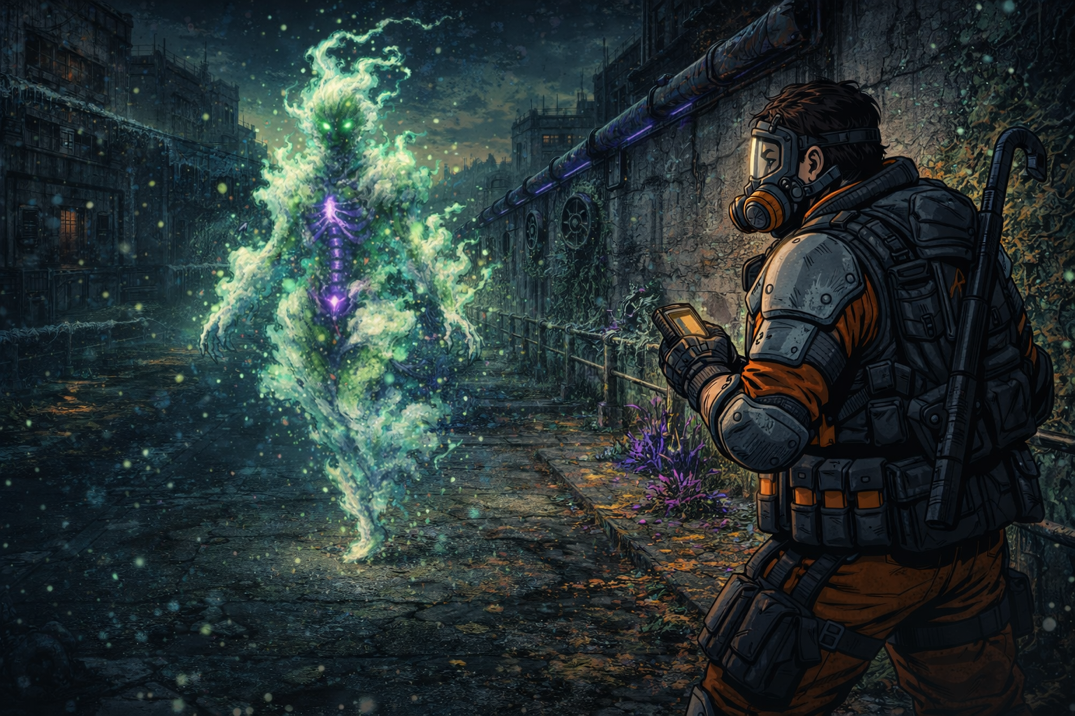
The cloud drifted from the mouth of a ventilation shaft sixty metres ahead, and it moved wrong. Steam disperses upward and outward, thinning as it goes. This held together. It maintained a shape — vaguely human, approximately human-sized, but with edges that trailed and dissolved and reformed like smoke in a bottle. It moved laterally, against the prevailing wind, following the line of ventilation outlets as though navigating by some internal compass.
Bioluminescent green pulsed faintly at its centre, where a face should have been.
Vera’s sensor screamed. Mutagenic particulate spiked to ninety-seven parts per million and kept climbing. She immediately backed off, putting distance between herself and the drifting shape, and watched through her visor as it passed the storm drain and continued its path. Where it drifted, the contamination bloomed. The concrete beneath darkened. The existing growths reached upward. A steel railing developed a sheen of organic film in the seconds it took the cloud to pass.
Pollen. She’d read the briefings. Aerosol bioweapon. Former person. Barely corporeal. Essentially impossible to contain with conventional methods.
What the briefings hadn’t mentioned was the pattern. Pollen wasn’t wandering. It was following a route — ventilation outlet to ventilation outlet, storm drain to storm drain. Pausing at each point long enough for the spores to saturate the area before drifting to the next. Like a gardener working through rows.
Vera watched it move to the next outlet, pause, and drift on. Methodical. Patient. Designed.
“Shit,” she said, flatly.
Pistonbreaker arrived in twenty-eight minutes, which Vera appreciated. Kess Vann came up the access road in full Ironheart assault gear — reinforced work clothes, heavy boots, three improvised weapons strapped to various parts of her body — and stopped when she saw Vera standing quietly by the deactivated scout marker.
“You look calm,” Kess said. “That’s bad.”
“Contamination zone has advanced a hundred metres past the scout line,” Vera said. “Growth follows ventilation infrastructure. Airborne deployment. And I saw Pollen.”
Kess’s expression didn’t change — it was already a permanent scowl — but something behind her eyes hardened. “The cloud? Here?”
“Following a route. Outlet to outlet, drain to drain. Not random drift. Pattern deployment.” Vera pulled up her sensor readings and showed them. “The gradient is too steep and too organised. Someone mapped the ventilation system before they sent it up.”
Kess stared at the readings, then at the contaminated buildings beyond the marker. “That’s inside our perimeter response range.”
“I know.”
“If it’s following the ventilation grid, it’ll hit the Median connector shafts in —”
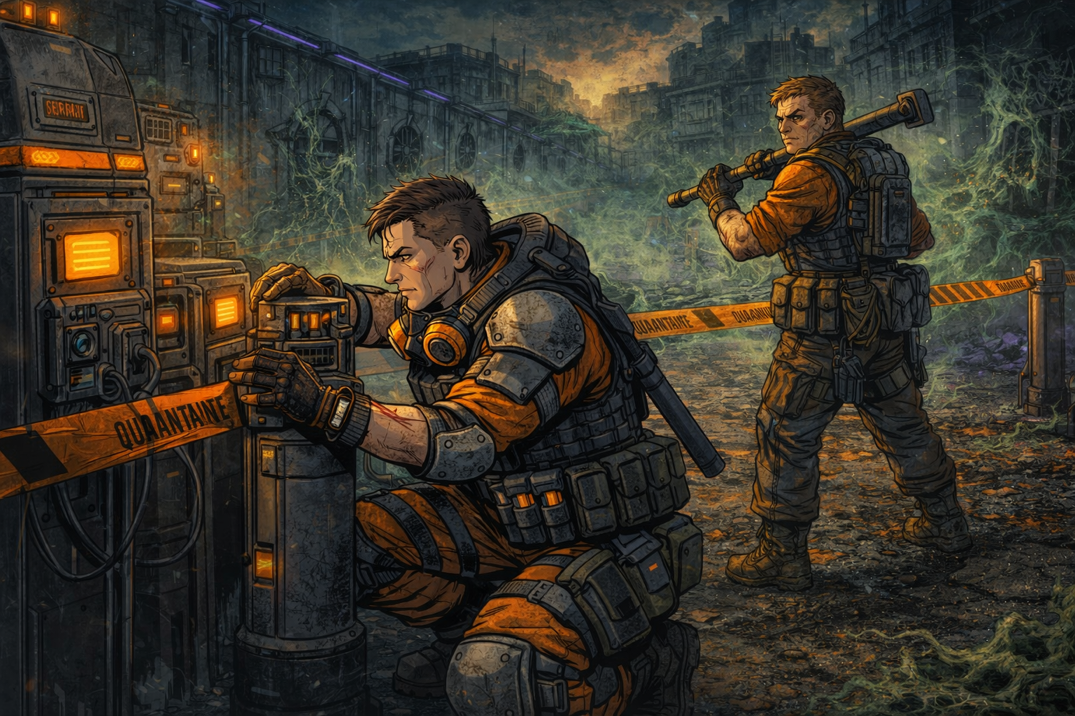
“Four days. Maybe three if the Aether feed increases.” Vera pulled a roll of hazard tape from her belt and began marking a new perimeter line — a hundred metres closer to friendly territory than the scouts had drawn. “I need barriers here. Sealed atmospheric barriers, positive pressure, full filtration. Every ventilation shaft between this line and the Crucible gets emergency sealed. Nothing comes through without hazmat clearance.”
Kess nodded once, already calculating. Her null field wouldn’t stop spores — that was biological, not Aether — but she could shut down any enhanced Fleshbound that tried to protect the deployment route. “I’ll hold the physical line. You seal the infrastructure.”
“That’s the plan.” Vera finished marking the first barrier position and straightened up. “I need to make a call.”
She keyed to Ironheart’s command frequency — secure channel, encrypted, routed through the Crucible’s hardened communication array. It took three seconds for the connection to resolve.
“Edda, it’s Vera.”
“Go ahead.” Edda Brann’s voice came through steady and clear, the way it always did. No matter what you told Edda, she listened like she was evaluating a structural blueprint — calmly, completely, before deciding where to put the support beams.
“The contamination has advanced past the scout line. Minimum one hundred metres. Growth pattern follows ventilation infrastructure — someone mapped the air system before deployment. I have a confirmed Pollen sighting at the border. It’s following a methodical route through the outlet network.”
Silence. Two seconds. Three.
“How far can it reach?” Edda asked.
“If it follows the ventilation grid and the Aether feed holds, the Median connector shafts in three to four days. After that, every air system in the eastern Median.” Vera paused. She didn’t soften things. Softening things got people killed. “Edda. This isn’t a breach. Someone planned this — mapped the infrastructure, engineered the delivery mechanism, timed the deployment. This is a campaign.”
More silence. Then Edda’s voice, quieter now but no less steady: “What do you need?”
“Sealed barriers at the new containment line. Emergency shaft closures between here and the Crucible. Hazmat teams for decontamination of affected structures. And people, Edda. A lot of people. Because I can seal the shafts, but I can’t stop what’s already in the air. And whatever Fleshbound is doing down there, they’re not finished.”
“You’ll have them.”
“Send them fast.”
Vera ended the call and looked at the contaminated skyline. Beyond the new marker line, the buildings wore their infections openly now — organic growths climbing walls, windows clouded with membrane, ventilation outlets trailing wisps of spore-laden air that caught the Scar’s volcanic glow and turned it sickly green. Somewhere in that mess, Pollen was still drifting. Still following its route. Still doing exactly what it had been designed to do.
She reached into her vest’s left chest pocket and touched the battered detonator — her father’s, the one he’d carried the day the building came down wrong and took him with it. She carried it as a reminder. Buildings don’t care about your plans. Problems don’t wait for you to be ready.
“You going to be alright out here?” Kess asked, not because she cared about Vera’s feelings — neither of them operated that way — but because operational readiness mattered.
“I’ll be fine.” Vera dropped her hand from the detonator and began unpacking her barrier equipment. Shaped charges for emergency shaft demolition. Sealant canisters for ventilation closures. Atmospheric sensors for the new perimeter stations. Everything precise. Everything in its place. “This is what I do.”
Kess grunted — which was as close to agreement as Pistonbreaker ever got — and moved to take up her position at the physical line, improvised piston rod across her shoulders, null field humming faintly in the cold air.
Vera worked. She set up the first barrier station with the efficiency of someone who’d built quarantine lines in worse places. But as she worked, she kept glancing at the horizon where the Scar’s heat haze met the Frost Quarter’s cold, where the air shimmered with something that wasn’t just temperature differential.
She’d contained breaches before. Tunnel collapses. Chemical spills. Isolated Fleshbound incursions. Things with edges. Things you could cut out.
This didn’t have edges. This was in the air, in the ventilation, in the infrastructure itself. It was spreading the way a crack spreads through a load-bearing wall — quietly, invisibly, until the day the whole thing comes down.
Vera knew buildings. She knew how they fell. And she knew the particular silence that came just before a structure failed — a settling, a shift, a moment where everything looked fine right up until it wasn’t.
That’s what this felt like.
She checked her atmospheric sensor one more time. The amber readings had stabilised at the new perimeter line, which meant the barriers were holding. For now.
She pulled her gas mask tighter and went back to work.