Open Market
Null Crow auctions Fleshbound intelligence as the Bloom spreads across Elarion
Open Market
The room cost Null Crow nothing, which was the most expensive price in the Night Market.
They’d earned it six years ago — a single piece of intelligence, delivered to Kade Moros at exactly the right moment, that prevented something unpleasant from becoming something catastrophic. Kade had asked what they wanted. Null Crow had named their price: one room, one night, their discretion. A deferred payment. The kind of debt that appreciates with time.
Tonight, they collected.
The backroom sat behind Merchant Row, two levels below the Market’s main thoroughfare, accessed through a door that most people walked past without seeing. Stone walls. Vaulted ceiling. No windows, no external vents, and only two exits — one visible, one that Null Crow had mapped but never shared. They arranged four chairs around a salvaged steel table and placed a single Aether lamp at its centre, casting the space in pools of soft purple light that made faces hard to read. This was deliberate. Auctions worked better when buyers couldn’t study each other’s eyes.
Their encrypted data pad sat on the table, dark for now. The intelligence inside it had taken two years to assemble. Surveillance devices planted in the margins of the Scar. Informants turned inside Fleshbound’s lower ranks. Timed incursions into ventilation corridors that any sane person would avoid. All of it compiled into a single package that, as of three days ago, had become the most valuable dataset in Elarion.
Null Crow had always understood one truth that other brokers forgot: information doesn’t become valuable when you find it. It becomes valuable when other people need it. And right now — with Pollen drifting through the Median’s air and Ironheart scrambling to hold a containment line that was already too close to home — everyone needed what they had.
They checked the exits one more time, adjusted the lamp, and waited.
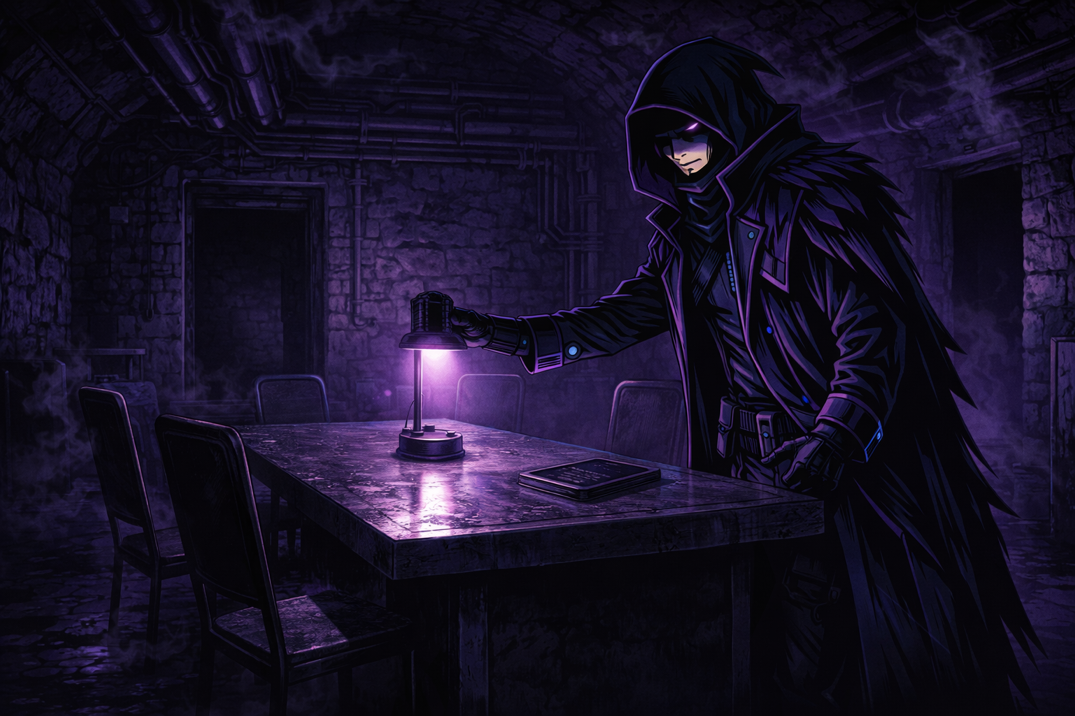
Vesper Thane arrived first, which told Null Crow everything they needed to know about Silvertongue’s level of interest.
Silvertongue never arrived early unless the merchandise was worth the vulnerability of being seen waiting. Vesper entered with the measured pace of someone who had been negotiating since before most of the Market’s traders were born, took the chair furthest from both exits, and set her leather portfolio on the table like a chess player arranging pieces. She wore silver and shadow black, gold accents catching the Aether lamp’s purple glow in a way that made her look expensive even underground.
“The market opens at the posted hour,” Null Crow said from the doorway. “I appreciate the interest, though. Speaks well of the asset.”
Vesper’s expression didn’t change — it never did. “Punctuality isn’t interest. It’s efficiency.”
“Everything’s currency, Thane. Even time. Especially time you’re spending in my room.”
The Sevenfold’s representative arrived next — a woman in crimson and black who took her seat without offering a name, as though her faction affiliation weren’t immediately obvious from the gambling tokens woven into her collar. She looked at Vesper, looked at the data pad, and folded her arms. Whatever the Sevenfold wanted, she’d been instructed to get it and leave.
The third buyer was a Veilwalker intermediary — hooded, quiet, taking the remaining chair with the careful movements of someone accustomed to being overlooked. They placed a cloth-wrapped payment on the table’s edge and said nothing. Null Crow catalogued the gesture. Pre-arranged currency. They knew the price would be high and had come prepared.
Then Vera Cask walked in.
She didn’t take a chair. She leaned against the wall beside the visible exit, crossed her arms over her reinforced tactical vest, and radiated the particular kind of displeasure that Ironheart operatives perfected in childhood. Her gas mask hung around her neck. The battered detonator was visible in her vest pocket. She examined the room the way she examined condemned buildings — measuring load-bearing weaknesses and calculating how many charges it would take to bring the whole thing down.
“No bid from Ironheart?” Null Crow asked.
“No bid,” Vera said. “We don’t pay profiteers.”
“Then I believe the word is observer.” Null Crow turned the data pad’s screen toward the table, and it bloomed to life — scrolling blueprints, contamination maps, and specimen catalogues rendered in cold blue and purple light. “Which brings us to the main event.”
The data was comprehensive.
Fleshbound laboratory coordinates — not the obvious installations that anyone with a death wish could locate by walking into the Scar, but the deep ones: Lab Seven’s last confirmed position, secondary research facilities, supply corridors, and the ventilation network that Pollen was using as a deployment grid. Specimen manifests listing conversion subjects by date, mutation type, and survival rate. Contamination vector maps showing the Bloom’s planned expansion routes — where it had been, where it was going, and the infrastructure it would follow to get there.
Null Crow presented it with practiced ease. They highlighted the contamination vectors last — the piece every faction needed most badly, the one that would determine today’s final price.
“Current market valuation puts this dataset at approximately forty-eight verified Aether crystallographs,” they said, naming a figure that made even Vesper Thane’s composure flicker by a fraction. “Opening bid is twenty.”
The Sevenfold’s representative bid twenty immediately. She hadn’t been sent to negotiate.
“Twenty-two,” said the Veilwalker intermediary — their first words of the evening.
Vesper said nothing. She was watching Null Crow’s hands. Specifically, the way they held the data pad angled so the contamination vectors remained partially obscured. She knew the technique. Show enough to create urgency, withhold enough to preserve value. She’d used it herself in a hundred negotiations.
“Twenty-five,” said the Sevenfold representative.
“Twenty-seven.”
Null Crow leaned back, letting the bids climb. They could feel the room’s temperature rising — not physically, but economically. The Sevenfold needed the data to protect the Crimson Gambit from biological contamination that could shut down their entire gambling operation. The Veilwalkers wanted to understand Fleshbound’s Aether manipulation methodology. Vesper wanted leverage — the data itself was less important than the strategic advantage of possessing it before anyone else.
“Thirty,” Vesper said, entering the bidding with the calm precision of a surgical cut. Not too high. Not too aggressive. Just enough to signal that Silvertongue’s interest was real and funded.
“Thirty-two,” said the Sevenfold rep, her jaw tightening visibly.
“Thirty-five.” Vesper again. Patient. Unhurried. As if she were ordering a drink rather than purchasing the intelligence that would reshape Elarion’s strategic landscape.
The Veilwalker intermediary looked at their cloth-wrapped payment, performed some internal calculation, and withdrew their hand. Out.
Three became two. Null Crow watched the Sevenfold representative and Vesper Thane assess each other across the purple-lit table — one operating on urgency, the other on patience. From a broker’s perspective, it was a beautiful market dynamic: fear versus strategy, each driving the price in the same direction.
“Thirty-eight.”
“Forty.”
From the wall, Vera Cask watched without expression. She’d been reading the room since she arrived, and Null Crow knew it. Ironheart wouldn’t pay, but Ironheart was here — which meant Edda Brann wanted to know who would. The winner of this auction would determine Ironheart’s next move. Buy from whoever buys from me, Null Crow thought. The secondary market was always where the real profit lived.
“Forty-two,” said the Sevenfold representative, and everyone in the room heard the ceiling in her voice.
“Forty-five.” Vesper didn’t hesitate.
Silence. The Sevenfold rep stared at the data pad, at the contamination vectors scrolling across its surface, at the price of understanding what was killing her faction’s territory. Then she exhaled, unclenched her jaw, and stood.
“The Sevenfold will remember this,” she said to no one in particular, and left through the visible exit.
“Sold,” said Null Crow. “Forty-five crystallographs. Silvertongue buys. Transfer on confirmation of payment.”
Vesper opened her portfolio with the expression of someone who had expected to pay exactly this amount. The transaction completed in under a minute — encrypted transfer, verified receipt, data packet released. She rose, nodded once to Null Crow — the first genuine acknowledgement of respect she’d offered all evening — and left the room without ceremony. Her leather portfolio now contained intelligence that would reshape Silvertongue’s strategic position for the next several months.
Null Crow watched her go and allowed themself a single moment of satisfaction. Forty-five crystallographs. Their best single-transaction gross in four years.
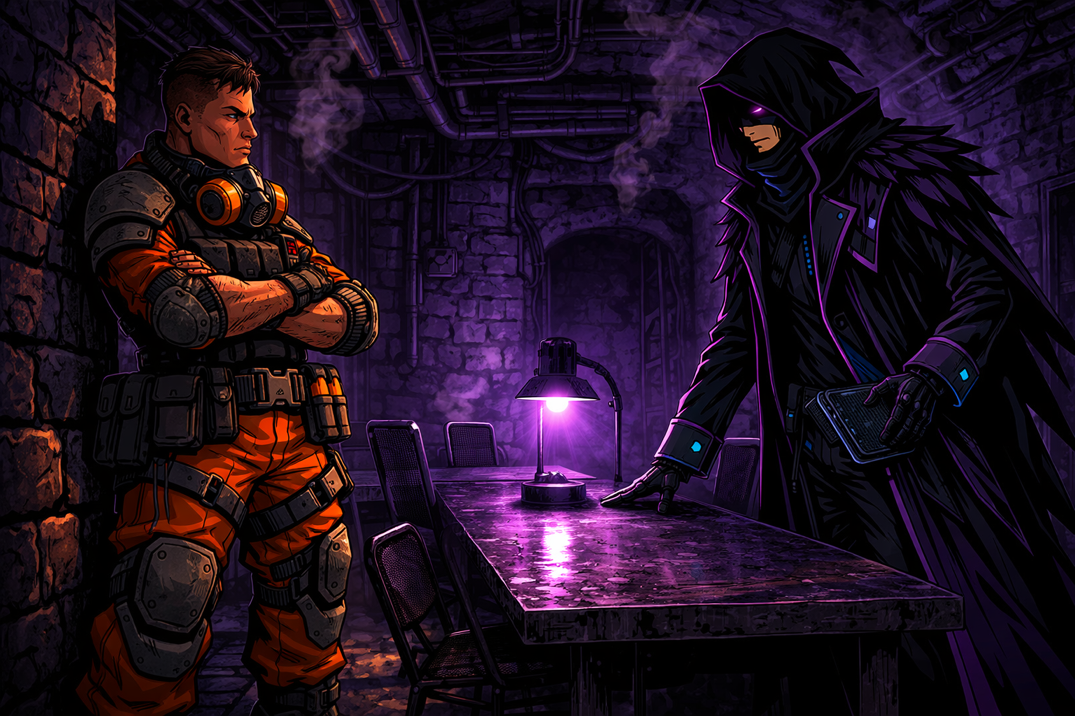
Vera hadn’t moved.
The room was empty now except for the two of them — the broker and the breacher, separated by a table with nothing left on it. Null Crow’s data pad was dark again. Vera’s arms were still crossed. The Aether lamp guttered between them, casting uneven shadows on the rough stone walls.
“You had that data for weeks,” Vera said. Her voice was flat, the way it sounded when she was reporting structural damage. “How long exactly?”
“Weeks is a broad term. What are you buying?”
“I’m not buying anything. People are dying, Crow. Contamination has passed your precious Night Market’s perimeter. Your customers are breathing Pollen spores — the vendors down the corridor have organic growth on their ceiling vaults. And you sat on actionable intelligence until you could bid it up to the highest buyer.”
“I didn’t sit on it. I valued it.” Null Crow straightened, pocketing their data pad in one smooth motion. “There’s a difference. Data without verification has no value. Data without a buyer has no purpose. I spent two years building this dataset — risking sources inside the Scar, running surveillance in corridors where the air rearranges your internal organs. That process has a cost. The cost determines the price.”
“People are dying,” Vera repeated, as though repetition would make the words heavy enough to crack something.
“People are always dying. That’s not a market condition. That’s baseline.”
Vera’s hands tightened against her arms. The burn scars on her forearms caught the light. “That contamination data could have been shared with every faction simultaneously. Joint response. Coordinated containment. Instead, Silvertongue has it. Silvertongue — who will use it for leverage, not lives.”
“Then Ironheart should have bid.”
“Ironheart doesn’t pay parasites for public health data.”
The word parasite hung between them like a detonation charge with the pin half-pulled. Null Crow’s thin mouth curved — not a smile, more like a notation. Filing the insult under future references, with its accompanying market value.
“Free information,” they said quietly, “has no accountability chain. If I distribute this data openly, every faction receives it simultaneously — including Fleshbound, who would know exactly which of my sources I compromised and which surveillance devices to destroy. My informants die. My network collapses. And the next time a crisis blooms and someone needs intelligence from inside the Scar, there’s no one left to provide it.” They tilted their head, the deep hood shifting to reveal one dark eye, glinting faintly purple in the lamp light. “Your open-source approach has a body count, Cask. You just don’t see it because you don’t work on the supply side.”
Vera stared at them for a long moment. Her jaw worked once, like she was biting through a blast wall.
“When we contain this,” she said, “you and I are going to have a longer conversation about civic responsibility.”
“I look forward to it,” Null Crow said. “I’ll invoice you for the consultation.”
Vera pushed off the wall and walked out. Her boots rang on the stone stairs — heavy, measured, angry. The sound faded into the Market’s constant murmur. The backroom settled into silence.
Null Crow stood alone in the purple light and performed their post-operation assessment.
Forty-five crystallographs secured. Three factions now aware that Fleshbound intelligence packages existed on the secondary market, which would drive demand for future offerings. The Veilwalker intermediary’s willingness to bid suggested institutional Aether research interest that could be cultivated. Vera Cask’s presence confirmed Ironheart’s position: they needed the data but refused to participate in the intelligence economy. An inefficiency in their approach. One that could be leveraged later.
Clean. Profitable. Controlled.
They scrolled through the data pad one final time, reviewing the fragments they’d kept — the portions too sensitive or too speculative to include in the auction package. Source identifiers. Collection timestamps. The trail of breadcrumbs that mapped how the intelligence had been acquired, piece by piece, over two years of careful work.
And then they paused.
It was a small thing. The kind of detail that only someone who had spent two decades in the intelligence trade would notice. The data on Lab Seven’s coordinates had come from an informant inside Fleshbound’s lower maintenance ranks — a turned custodian who’d provided access schedules, ventilation routing, and laboratory layouts in exchange for relocation assistance. Good tradecraft. Clean source. Exactly the kind of operation Null Crow had built their reputation on.
But the data had been easy.
Not obviously easy. Not suspiciously easy. Just… slightly easier than it should have been. The custodian had been marginally too willing to cooperate. The ventilation routes had been a fraction too well-documented. The specimen manifests had been just slightly too complete, as though someone had compiled them for another purpose before Null Crow’s informant ever accessed them.
As if the information had been arranged where it could be found.
Null Crow stared at the thought for three full seconds. Then they closed the pad, pocketed it, and moved toward the hidden exit.
The thought would surface again later. It always did. But by then, the data would be in Silvertongue’s hands, and the auction would be history, and the Bloom would have advanced another week, and there would be new intelligence to harvest and new buyers to cultivate and new prices to set.
And somewhere beneath the Scar, in a garden that no one was supposed to know about, something was already growing in exactly the direction it had been planted.