Carn Hollow
Bone Garden keeper who plants the dead; every grave becomes a garden, every corpse a seed.
Carn Hollow - “The Bone Garden Keeper”
Faction: Wildborn
Age: ~90 (appears skeletal/ancient due to mutations)
Origin: Elarion native
Role: Cemetery guardian and priest of natural cycles
Overview
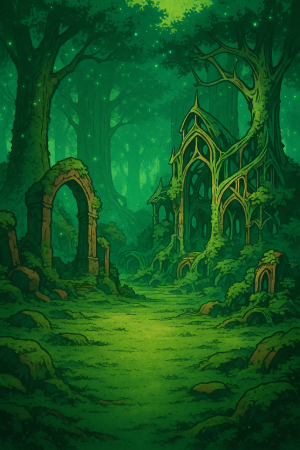
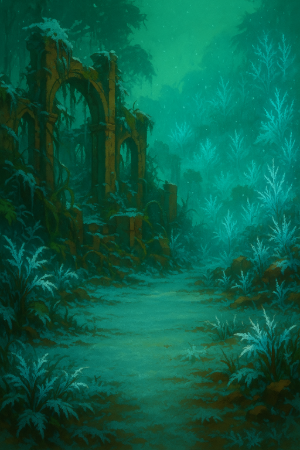
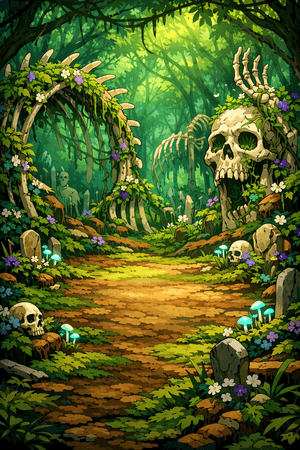
Carn Hollow is where the Wildborn go to die—and to be reborn. For over fifty years, he has tended the Bone Garden, a sacred grove deep within the Verdant Sprawl where deceased Wildborn are “planted” rather than buried. Their bodies become nutrients for Aether-infused growth, their bones become trellises for climbing vines, and their essence joins the living memory of the Sprawl itself. Carn is part priest, part groundskeeper, part historian—the keeper of Wildborn death and the midwife of their transformation into something eternal.
Before the Aetherfall, Carn Hollow worked in a small cemetery on Elarion’s eastern edge—the same ground that would eventually become part of the Verdant Sprawl. He was forty when the storm hit, and unlike others who fled or fought, he simply continued his work. The dead needed tending. The graves needed maintaining. When the Sprawl consumed the cemetery, Carn was consumed with it.
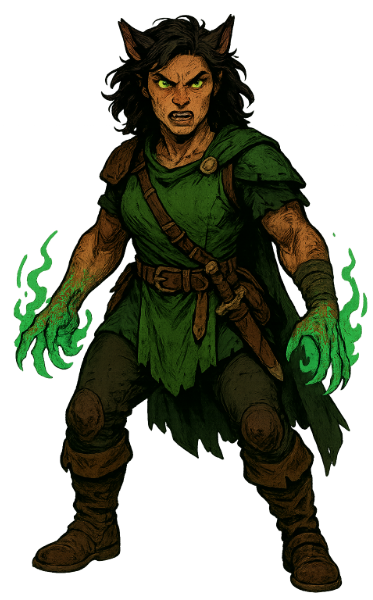
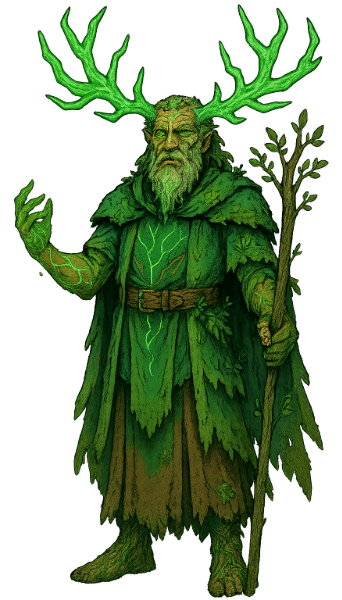
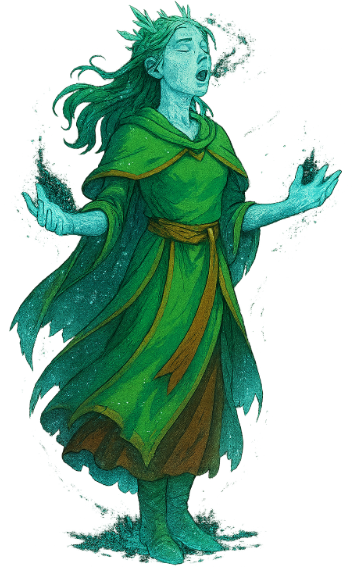
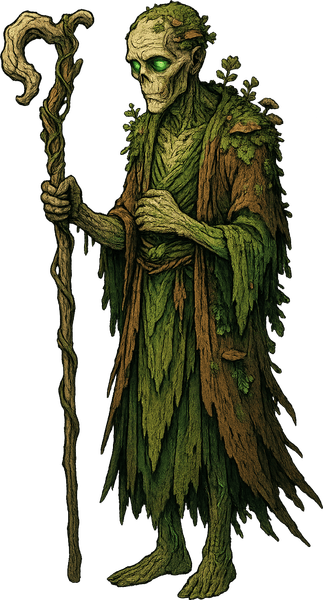
The transformation was gradual but profound. Over decades, Aether saturated his aging body, hollowing him out even as it preserved him. His flesh thinned to parchment stretched over increasingly visible bones. His eyes receded into sockets that now glow with soft green Aether light. Fungi colonized his skin, moss grew from his joints, and his fingers elongated into root-like appendages that feel more natural buried in soil than grasping tools. He became a walking bridge between the living and the dead—a man who looks like a corpse but pulses with the Sprawl’s vibrant life.
The Bone Garden emerged naturally from his work. When Wildborn began dying from mutations, faction conflicts, and the Sprawl’s dangers, Carn offered an alternative to abandonment or burning: plant them. Let the Sprawl reclaim them. Let their bodies nourish new growth and their bones support the living ecosystem. The practice spread until every Wildborn knew that death wasn’t an ending—it was a return to the Garden, where Carn would ensure they became part of something greater.
Personality
- Serene: Carn has made complete peace with mortality—his own and others’—viewing death not as tragedy but as transformation, a return to the cycle that sustains all life.
- Gentle: Despite his ghoulish appearance, he speaks softly and moves carefully, treating both the living and the dead with tender respect born from decades of sacred service.
- Philosophical: He communicates in gentle riddles and metaphors about cycles and renewal, finding truth in the patterns of growth, decay, and regrowth that define his world.
- Devoted: His role as Bone Garden Keeper is not merely a job but a sacred calling; he takes every aspect of his duty with absolute seriousness.
- Lonely: His companions are memories and the whispers of the dead; while content in his purpose, he carries the quiet isolation of one who exists between worlds.
Carn finds profound beauty in decay. Where others see horror in rotting flesh or crumbling bone, he sees potential—nutrients returning to soil, calcium strengthening new growth, essence rejoining the great cycle. He doesn’t mourn the dead; he celebrates their transformation. His warmth surprises those who meet him expecting a grim reaper figure; instead, they find a gentle soul who offers comfort through the simple truth that nothing truly ends.
Abilities & Aether Use
Carn’s relationship with Aether is passive and symbiotic rather than active and commanding. He doesn’t manipulate Aether so much as he has become part of its natural flow through the cycle of life and death. Decades of tending the boundary between the living and the dead have attuned him to frequencies of Aether that others cannot perceive—the echoes that remain when consciousness fades into the Sprawl’s living network.
Communion with the Dead:
- Can “hear” deceased Wildborn through the plants that grow from their remains—not voices exactly, but impressions, memories, emotional residue.
- Knows the complete history of every Wildborn interred in the Bone Garden, their stories preserved in the growth they nourish.
- Senses when Wildborn die anywhere in the Sprawl—a necromantic perception that alerts him to collect and properly inter the fallen.
- Can guide the bereaved to specific plants that contain echoes of their loved ones.
Garden Cultivation:
- Controls the specialized fungi, mosses, and plants that transform bodies into new growth.
- Accelerates or slows natural decomposition to optimize the transition from flesh to fertilizer.
- Cultivates bone-trellises—structures of intertwined skeleton and vine that serve as both memorial and living architecture.
- Communicates with the Garden’s ecosystem as a whole, sensing its health and needs.
Presence of Decay:
- His presence accelerates natural decomposition in organic matter—which he views as hastening the return to the cycle.
- Can slow this effect consciously when among the living, but it manifests unconsciously when he’s distressed.
- The effect nourishes plant life around him; flowers bloom in his wake, fed by microscopic acceleration of organic processes.
Limitations:
- His power is rooted in the Bone Garden; away from it, his connection to the dead weakens significantly.
- Cannot raise or animate the dead—he honors their transformation, not their resurrection.
- His accelerated decay effect makes close relationships difficult; prolonged contact ages organic material.
- The weight of centuries of memories sometimes overwhelms him, requiring solitary meditation to process.
- Physical frailty—his body functions more like animated plant matter than living flesh.
Relationships
Kor Emmer (Wildborn)
Kor consults Carn on matters of Wildborn tradition and history that predate even his own transformation. While Kor speaks for the living Sprawl, Carn speaks for its accumulated dead—together they represent the faction’s complete temporal span. Their conversations are infrequent but profound, two ancient beings discussing the nature of change and what the Wildborn truly are. Kor respects Carn as perhaps the only Wildborn who has achieved true peace with mutation, while Carn sees in Kor the living embodiment of what the Sprawl creates at its best.
Theron Moss (Wildborn)
Theron is the only other Wildborn old enough to remember the time before the Bone Garden existed—when the dead were simply left to rot or burned in makeshift pyres. They share memories of that chaotic era, the brutal early decades when Wildborn had no traditions and no community. Theron has told Carn stories of the dead that Carn now tends, providing context for echoes that might otherwise remain mysterious. In turn, Carn has assured Theron that when his long hunt finally ends, the Garden will remember everything he was.
Sahri (Wildborn)
Sahri and Carn represent two ends of the same thread—she fights death, he welcomes it. When Sahri’s healing cannot save someone, she sends them to Carn for proper interment. There is no failure in this transfer; both understand it as the natural completion of a journey. Sahri sometimes visits the Garden to sit among the growing memorials, finding peace in the knowledge that those she couldn’t save have become something beautiful. Carn appreciates her work precisely because it makes his meaningful—death only has weight because life fights to preserve itself.
Bramble (Wildborn)
Carn watches Bramble with a mixture of fascination and gentle sorrow. The child-creature represents something unprecedented—a Wildborn who may have transcended the cycle entirely. Carn wonders if Bramble will ever truly die, or if they will simply become indistinguishable from the Sprawl itself, spreading until there is no individual to mourn. He’s asked Bramble if they fear death; Bramble didn’t understand the question. This troubles Carn more than he admits—is deathlessness liberation or a different kind of loss?