House of Odds
A Sevenfold analyst discovers the architecture behind the fabricated intelligence
House of Odds
Roz Alaric counted seventeen steps down to the archive and estimated a 40% chance the ledger-keeper would refuse to talk to her.
She’d prepared for all outcomes. The Sevenfold’s transaction ledgers were loaded on the data-pad under her arm, three months of secondary-channel intelligence purchases cross-indexed by date. Her satchel held printed records that Marlon Vetch had annotated with the painstaking clarity of a man who hated messy data even more than she did. She also had a direct mandate from Roach, which was worth more than crystallographs in most of Elarion and nothing at all in Nocturne’s territory.
The archive smelled of candle wax and old leather. Behind a desk stacked with open pages sat a thin figure in dark charcoal robes, a massive leather-bound ledger held open with one ink-blackened hand.
Pale grey eyes flicked up. Catalogued her. Returned to the page.
“Sevenfold,” Seren Dusk said. Not a greeting. An entry.
“Roz Alaric. Intelligence analyst.” She rolled a counting chip across her knuckles — casino gold catching the candlelight. “I’m here about your margin notes.”
The quill paused. A pause from Seren was, by Roz’s calculation, the equivalent of someone else standing up and swearing.
“Wren Sable consulted my records. I don’t interpret—”
“I know. You record. I interpret.” Roz set the data-pad on the only clear corner of the desk. “The Sevenfold purchased Fleshbound intelligence through seven different brokers over the past two years. None of them were Null Crow. Different sellers, different access points, different pricing structures.” She tapped the screen. “I need to compare our acquisition chains against your supply chain records for the same period.”
“Because 31% of our data contradicts itself, and I don’t believe in coincidence at those volumes.”
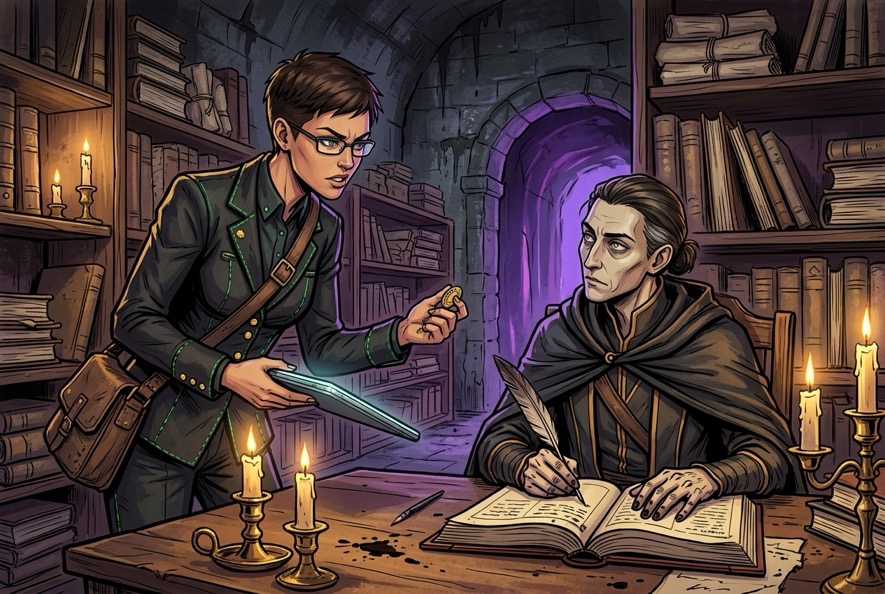
Seren brought out the red-ink volume.
They worked for four hours. Roz had expected two. She sat on a crate Seren had cleared for her, the data-pad propped on one knee and printed records fanned across the stone floor. Seren’s ledger lay open between them, the red margin notes glowing like wounds in the candlelight. Roz’s stylus moved in quick strokes — circling, connecting, annotating.
The Sevenfold’s records told one story. Seren’s told another. Together, they told a third.
Every piece of Fleshbound intelligence that had entered the Night Market in the past two years — every contamination map, every specimen manifest, every lab coordinate — traced back through the same structural architecture. The brokers were different. The contacts were different. But the data itself shared formatting conventions, timestamp cadences, and classification hierarchies that were identical to within 2% variance.
Two percent. Roz stared at the number and felt the particular thrill of a pattern resolving into certainty.
“It’s the same hand,” she said.
Seren’s ink-stained fingers were motionless on the page. “Explain.”
“Seven independent sources should produce 15% structural variance minimum. Methodology differences, formatting habits — everyone does it differently. That’s the signature of real intelligence.” She turned the data-pad toward Seren. “1.7% variance across twenty-three months. The probability of that occurring organically is point zero zero three percent.”
The archive was very quiet.
“Someone designed it,” Seren said. Not a question.
“Someone designed all of it. Every broker, every intermediary, every access point that looked independent was fed from the same upstream source. Null Crow’s auction wasn’t the beginning — it was the distribution event for a supply chain that was already two years old.”
Roz rolled a counting chip across her knuckles — hands busy, brain working.
“I need copies of the margin-note entries. 6,891 through 7,341. And the timestamp indices for every Fleshbound transaction since Year 98.”
Seren stared at her. Then reached for their quill. “The ledger doesn’t leave the archive. But I’ll transcribe.”
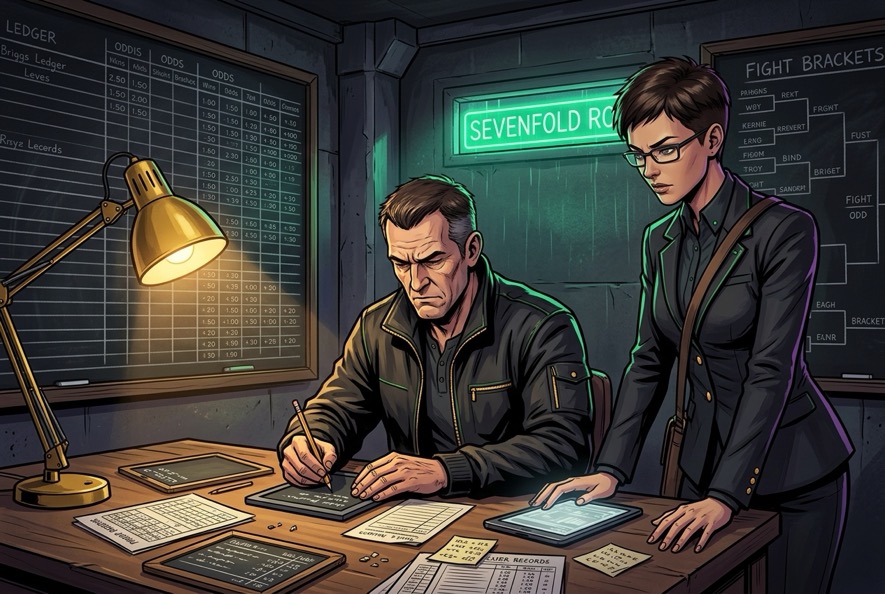
Briggs Halden didn’t look up from his line board when Roz entered the office above Sevenfold Row’s secondary floor. Pencil behind his ear, compact slate covered in numbers that made the House’s violence look like mathematics.
“Halden.” She dropped the data-pad on his desk. “Run this through the expanded exposure model. Pricing response curves and intermediary overlap included.”
He read the screen in silence for forty-five seconds. Roz counted. Briggs was the only person in the Sevenfold who processed data slower than she did, because he refused to accept a number until he’d checked it twice.
“This is your variance figure?” He pointed at the 1.7%.
“Cross-referenced against Seren Dusk’s transaction indices and our own acquisition records. Twenty-three months.”
Briggs pulled the pencil from behind his ear and began writing — tight, neat, completely manual. He distrusted anything that ran on a screen.
Three minutes. He set the pencil down.
“Point zero zero one percent. Five-sigma confidence.”
“So.”
“So it’s not coincidence.” The flat, unimpressed expression of a man who’d spent twenty years making sure the House’s math never became wishful thinking. “Every piece of Fleshbound intelligence on this market was manufactured by the same source. Your pattern holds.”
Roz nodded. She’d known. But hearing Briggs say it turned her analysis into something heavier. A weapon the House could use.
“Who gets the report?” she asked, though she knew the answer.
“You know who gets the report.”
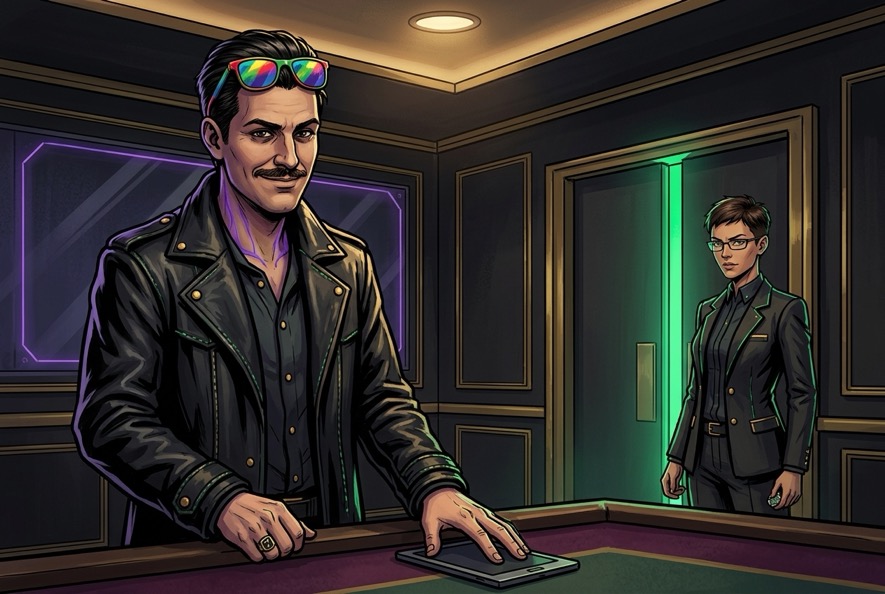
Roach read it in the quiet room behind the Row’s main floor. He’d pushed his mirrored lenses up into his dark hair, revealing eyes that tracked the data-pad’s screen the way a dealer tracked a marked card.
Roz stood by the door. She’d presented the summary in three sentences — manufactured intelligence ecosystem, single upstream architect, two-year operation predating Null Crow’s auction. Briggs’s probability confirmation was appended.
Roach scrolled. Read. Scrolled again.
“You’re saying someone built the Night Market’s entire Fleshbound intelligence supply.” Soft, interested — the tone of a man appraising a hand he hadn’t dealt.
“99.999% probability.”
“And every faction that bought Fleshbound data — Silvertongue’s forty-five crystallograph package, our secondary acquisitions, the Veilwalker purchases—”
“Compromised. All of it. Designed to look like intelligence. Architecturally identical underneath.”
Roach was quiet for six seconds — an eternity for a man who controlled conversations the way he controlled a deck. Then the smile came. Not the warm, public smile he used on the Row’s floor. Something thinner. Colder.
“Nobody else has this?”
“Wren Sable and Seren Dusk have pieces. But neither has the structural proof — that required cross-referencing against our financial records.”
Roach picked up the data-pad — not to read but to weigh, like a chip he was deciding whether to play.
“We sit on it,” he said.
Roz had calculated a 78% probability he’d say exactly that.
“Every faction in this city is operating on poisoned data. That’s not a crisis, Alaric. That’s leverage.” The smile widened a fraction. “Knowledge of the manipulation is worth more than the intelligence itself. We don’t publish. We don’t warn. We wait until knowing is worth more than telling.”
He slid his sunglasses back down. “The House always plays the long game.”
Roz slipped the counting chip into her pocket, casino gold warm against her fingers. She’d found the pattern. She’d priced the confidence. And now the answer belonged to Roach, which meant it would be deployed when the math said it was profitable and not one second before.
She turned and walked back toward the Row’s neon-lit corridor, data-pad already open to the next cross-reference.
The numbers never stopped talking. Roz never stopped listening.