Decaying Returns
Corvin Pale delivers his devastating analysis — Vesper's 45-crystallograph purchase is worthless
Decaying Returns
The data crystals on Corvin Pale’s desk glowed pale blue in the dark, casting cold light across seventy-two pages of annotated findings. He’d verified the analysis three times. He’d verified it a fourth time at two in the morning, running on Aether microdoses and the particular dread of a man who wished his own conclusions were wrong.
They weren’t.
Intelligence Package NC-4412-V: Overall confidence rating: 0.7%. Recommendation: Full strategic withdrawal. No recovery pathway identified.
Zero point seven percent. Out of forty-five Aether crystallographs — the largest single intelligence transaction in Night Market history — forty-four and two-thirds had bought nothing.
Corvin gathered the crystals, slotted them into their encrypted folio, and straightened his charcoal coat. The faint purple Aether scarring at his right temple throbbed — weeks of enhanced cognition extracting their toll in insomnia and a persistent ache behind his eyes. He caught his reflection in the dark terminal screen: sharp cheekbones, dark circles, grey streaks at the temples that seemed more pronounced every morning.
You look like your own autopsy report.
He walked toward Vesper Thane’s negotiation suite on the floor above.
The suite overlooked the Drowned Coast through reinforced glass that sweated with condensation. Tidal fog pressed against the windows, turning the port lights below into smeared gold.
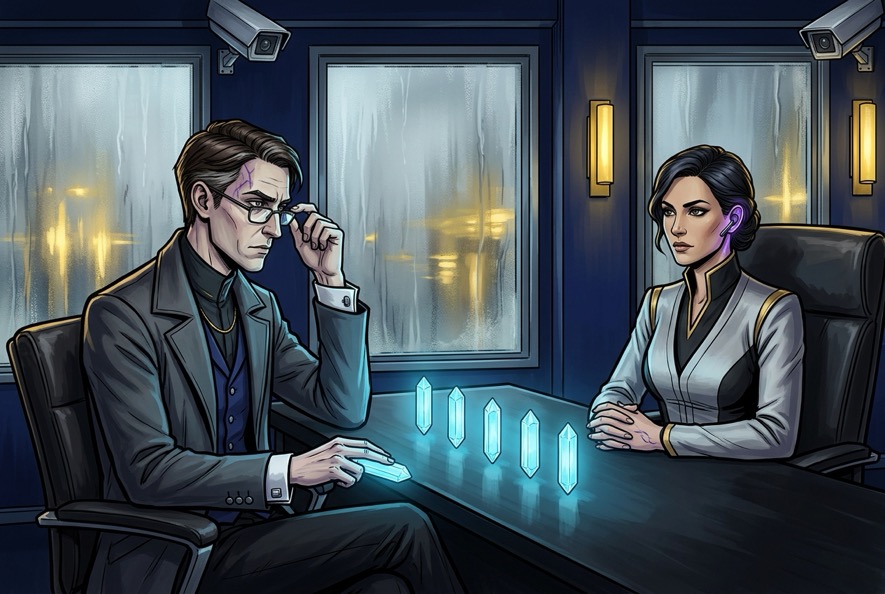
Vesper Thane sat behind her desk. Dark hair pulled back. Expression neutral. The Aether-infused earpiece at her left ear glowed faint purple. Her hands were folded, fingertip scarring invisible against the shadow black surface.
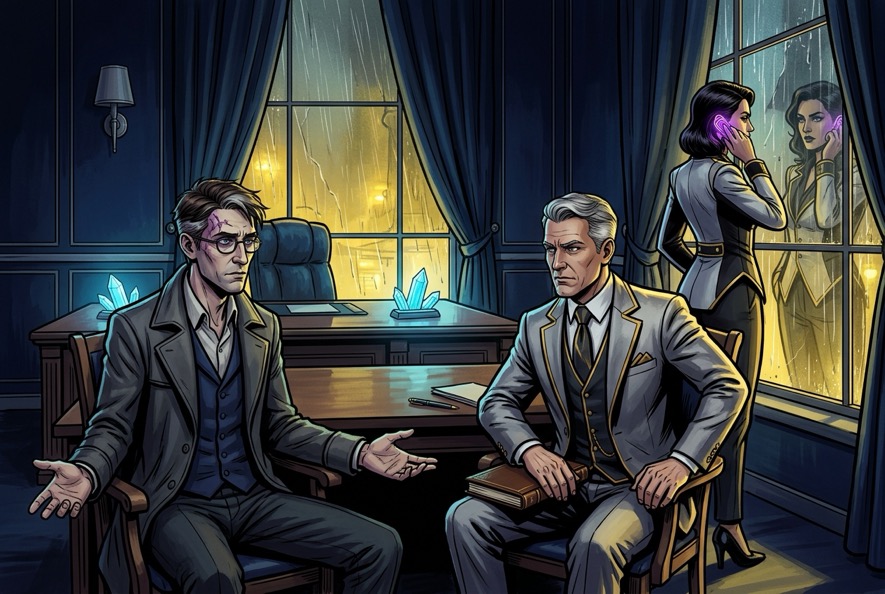
Sterling Graves occupied the chair to her right. Immaculate grey hair. Pre-Aetherfall suit in silver and black. His leather-bound ledger lay closed on his knee, expensive pen positioned with surgical precision. He looked at Corvin the way he looked at balance sheets — assessing exposure.
“Sit,” Vesper said.
Corvin sat and arranged five data crystals in a line between them. “The Fleshbound intelligence package is compromised. Not partially. The dataset is structurally unsound across every category.”
He pushed up his glasses and tapped the first crystal. “Lab coordinates. Seven sites. All vacated a minimum of three weeks before the data reached the Night Market. Four show demolition signatures. The remaining three have no residual Aether trace.”
Sterling’s pen moved — a note in the margin of a ledger that contained, among other things, forty-five crystallographs that were no longer retrievable.
“Specimen manifests. Two hundred and thirteen referenced subjects. Eighty-nine percent appear in no other dataset. Fabricated.” He met Vesper’s eyes briefly. “The remaining eleven percent are real — distributed through the fabrication to pass surface-level authentication. It’s sophistication, not carelessness.”
“Contamination vectors,” Vesper said. Not a question.
“Outdated by three weeks minimum. The dispersal patterns don’t match current Aether flow dynamics. I confirmed this against an independent Veilwalker probability survey.” He adjusted his glasses. “The dataset was designed to become wrong. Lab coordinates cleared before sale. Manifests salted with authentication bait. Contamination data describing a reality that expired weeks before anyone received it. A document with a built-in expiration date.”
Rain began against the windows — the Drowned Coast’s climate shifting from fog to downpour in the time it took to ruin a forty-five-crystallograph investment.
Sterling spoke first. “Recovery options.”
“None. Night Market escrow — irreversible. The data was technically authentic at the point of sale. Contamination occurred upstream. No contractual basis for reclamation.” Corvin spread his hands. “I’ve explored seven creative interpretations. None survive scrutiny. The crystallographs are spent. The intelligence is worthless.”
Sterling closed the ledger with the controlled patience of a man watching a number he couldn’t change.
Vesper hadn’t moved. Corvin watched her the way he watched data — looking for the pattern beneath the surface. Three years of assessments had taught him her micro-expressions: the jaw clench that preceded anger, the narrowed eyes that signalled recalculation, the single blink that meant she’d already decided.
She gave him the single blink.
“Who benefits?”
Not how did this happen. Not who’s responsible. The question that mattered: who benefits from Silvertongue acting on fabricated data?
He placed the fifth crystal in her palm. “The architecture is single-source. The access pathways, the turned informants, the timing — it points to strategic thought Fleshbound’s known leadership doesn’t demonstrate. Whoever built this anticipated the auction, the bidding patterns, and the operational decisions buyers would make.” He paused. “They anticipated us.”
Vesper turned the crystal in her fingers. Pale blue light caught the Aether scarring on her fingertips.
“Fleshbound has an architect.”
“A strategist. Patient enough to plant intelligence over eighteen months and sophisticated enough to route it through an unwitting broker. This isn’t a laboratory mind. It’s an operational one.”
“Null Crow.” Sterling’s voice was flat. Financial. A man identifying where loss had entered the ledger.
“An intermediary,” Corvin corrected. “My analysis can’t determine complicity or compromise. If they were used, they’re a victim. If complicit—”
“A problem.” Vesper set the crystal on the desk. “Until we know which, they’re a variable.”
She stood and walked to the window. Rain hammered the glass. Below, the port lights swam in dirty gold through running water. Corvin understood — with the clarity of someone who studied patterns for a living — that Vesper’s response to losing forty-five crystallographs was not rage and not despair.
It was recalibration.
“Sterling. Freeze all expenditure derived from the Fleshbound intelligence. Pull field teams from the lab coordinates. I want our own data, gathered by our people, trusted by nobody except us.”
“Done.”
“Corvin. Full provenance audit of Null Crow’s source chain. Every access pathway, every turned informant. If there’s an architect, the architecture will show me where they stand.”
A promotion disguised as a punishment.
“And Corvin.” He paused at the door. “This report is classified above my office. Sterling, myself, and you. Not the Council. Not Operations. Not the analysts you share workspace with. Clear?”
“Transparent.”
A faint movement at the corner of her mouth. Not quite a smile.
Across the city, in the tunnels beneath the Night Market, Null Crow heard the first whisper.
Not through their surveillance network — through the information economy itself. Three Silvertongue operatives who’d been active in secondary markets for weeks had gone silent simultaneously. A standing order for Fleshbound contamination updates, renewed weekly for two months, was cancelled without explanation.
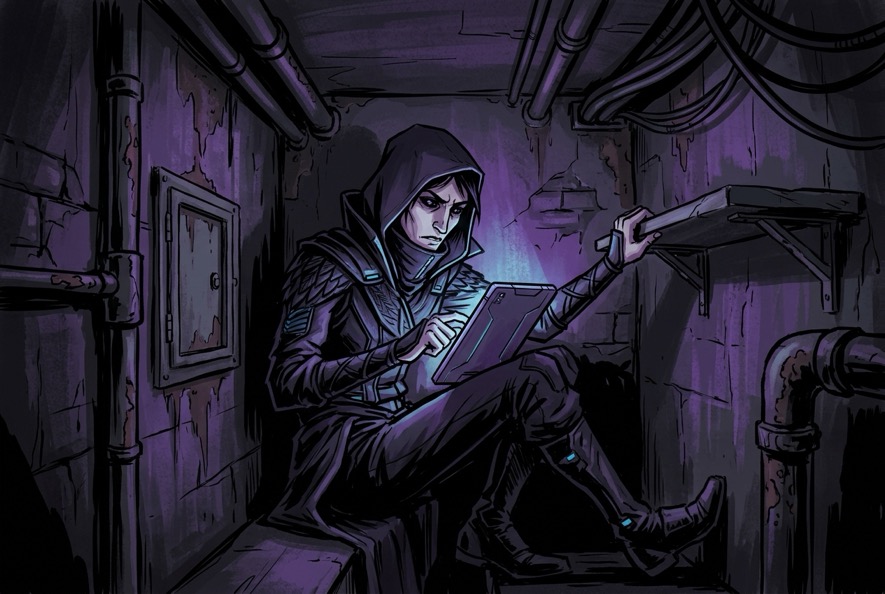
Null Crow sat in a safe house they’d use once and never return to, data pad casting blue light across the cramped space, and calculated.
Silvertongue was pulling back. Vesper Thane didn’t pull back without reason. Which meant someone inside her operation had done exactly what Wren Sable had done from outside it — looked at the data and found it empty.
Two independent sources is coincidence. Three is a pattern. Four is a fact.
Null Crow opened a separate channel — encrypted, single-use, routed through six dead drops that would burn the moment the message sent. They began composing a query to their Fleshbound contacts. Not the standard request. Something that asked, for the first time, not what the contacts could provide but how they had originally made themselves available.
For the first time in their career, Null Crow was examining the architecture of their own supply chain with the systematic suspicion they normally reserved for other people’s data.
The answer might be more expensive than forty-five crystallographs.
It might cost them the only thing they’d never put a price on: the belief that they were the ones in control.